
Return to the Moon
Season 53 Episode 7 | 53m 8sVideo has Closed Captions
Follow the Artemis mission to bring humanity back to the Moon for the first time since Apollo.
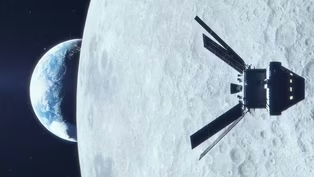
A half-century after Apollo, the Artemis missions aim to bring astronauts back to the Moon and establish a lunar space station. Follow the Artemis II engineers and crew on the perilous 10-day journey to orbit the Moon.
Problems playing video? | Closed Captioning Feedback
Problems playing video? | Closed Captioning Feedback
Major funding for Return to the Moon is provided by the Heising-Simons Foundation. Additional funding is provided by the George D. Smith Fund, Inc. National Corporate funding for NOVA is...
Support provided by:


Return to the Moon
Season 53 Episode 7 | 53m 8sVideo has Closed Captions
A half-century after Apollo, the Artemis missions aim to bring astronauts back to the Moon and establish a lunar space station. Follow the Artemis II engineers and crew on the perilous 10-day journey to orbit the Moon.
Problems playing video? | Closed Captioning Feedback
Where to Watch NOVA
NOVA is available to stream on pbs.org and the PBS app.
Buy Now

NOVA Labs
NOVA Labs is a free digital platform that engages teens and lifelong learners in games and interactives that foster authentic scientific exploration. Participants take part in real-world investigations by visualizing, analyzing, and playing with the same data that scientists use.Providing Support for PBS.org
Learn Moreabout PBS online sponsorship♪ ♪ GENE CERNAN: We leave as we came, and, God willing, as we shall return.
♪ ♪ NARRATOR: After more than 50 years, humanity has finally returned to the moon.
♪ ♪ To get there, NASA needed a new rocket that packs a punch.
BILL NELSON: 8.8 million pounds of thrust at liftoff.
REID WISEMAN: I call it the arrogance of humanity.
The fact that we think we can launch machinery like this, it just leaves you with a sense of awe.
NARRATOR: How did they build it?
JOHN BLEVINS: This is like no other kind of atmospheric machine.
We design for every iteration that could occur between liftoff and orbit.
MAN: Copy, burning.
NARRATOR: What were they up against?
MAN: Copy.
ANDREA LEINFELDER: China's space program is more advanced than I think a lot of people realize.
ERIC BERGER: When you see something that anomalous on a critical system like the heat shield, where there's no backup, that really raises your concerns.
(explosion echoes) MAGGIE ADERIN: They've mitigated the risk as much as possible, but there still could be a catastrophic failure and loss of life.
NARRATOR: The inside story of Artemis II, from design to splashdown.
"Return to the Moon," right now, on "NOVA. "
♪ ♪ ♪ ♪ ♪ ♪ NARRATOR: April 1, 2026.
It's launch day for the crew of Artemis II.
♪ ♪ Commander Reid Wiseman, pilot Victor Glover... ...two mission specialists, Christina Koch and Canadian Jeremy Hansen.
They're about to fly on the most powerful rocket NASA has ever built, the Space Launch System.
♪ ♪ WISEMAN: As you get out to the pad, you can look all the way up and see the top of the rocket.
It's full of fuel, so it'll be venting, it'll be cold, it'll be alive.
♪ ♪ And we are just teeny, tiny specks amongst this 280-foot-tall rocket in front of us.
We'll get in an elevator, we'll ride that elevator up to the 274 level.
And we walk down the gantry to the White Room.
Put on our helmet, put on our gloves, make sure we look good from head to toe, and then one at a time, we'll go into the Orion and start getting strapped in.
♪ ♪ NARRATOR: Artemis II is the first crewed mission to the moon in over 50 years.
The astronauts will travel farther from Earth than any humans have traveled before, paving the way for future missions to land on the lunar surface.
♪ ♪ ADERIN: When a rocket launch is going ahead, it is almost like poetry in motion.
Everything has to be in perfect alignment before they will give the go-ahead for a launch.
♪ ♪ BERGER: You've got four human beings sitting on top of a massive bomb.
If the detonation is controlled properly, then the rocket goes up and they go to space.
But if something goes wrong, that rocket blows up.
♪ ♪ JEFF SPAULDING (on radio): OTC.
WOMAN (on radio): TC is go.
NARRATOR: It's taken decades to get here.
The risks are enormous.
SPAULDING (on radio): MCO.
MAN (on radio): T.O.
is go.
NARRATOR: But now it's finally time.
Time for humans to go back to the moon.
WISEMAN (on radio): Artemis II crew is go for launch.
CHARLIE BLACKWELL-THOMPSON (on radio): I copy that.
Good luck.
Godspeed, Artemis II.
Let's go.
♪ ♪ ♪ ♪ NARRATOR: Three years before the launch of Artemis II, NASA launches Artemis I. A test flight to the moon and back without astronauts on board.
♪ ♪ BLACKWELL-THOMPSON: There are things that we've done many times in sims, and we've done them many times in the lab, but in a tanked configuration at the pad, it was the first time.
It is incredibly quiet in the room.
Everybody is focused on their system, they're focused on the data.
I mean, there's not a sound.
♪ ♪ NARRATOR: It's the first flight of the Space Launch System-- SLS-- the rocket specially built for the Artemis program.
Five million pounds of fuel has to ignite on cue to lift the rocket into space.
BERGER: Rockets are insanely complex vehicles where everything has to go right for it to succeed, and if a single important thing goes wrong, the rocket blows up.
I mean, it is the ultimate kind of pass-fail test.
DERROL NAIL: And here we go.
MAN (on radio): Ten... BLACKWELL-THOMPSON: I got a bit of a... The hair on my arms stood up just a little bit as those final six seconds ticked off the countdown clock.
NAIL: Six, five, four, stage engine start.
BLACKWELL-THOMPSON: And then the call.
"Booster, ignition, and liftoff."
NAIL: Three, two, one... BLACKWELL-THOMPSON: "Liftoff of Artemis I."
(engines roaring) ♪ ♪ It was... It was breathtaking.
LEAH CHESHIER: Good control on the roll from teams on mission control, Houston.
All good calls so far, now 30 seconds into the flight of Artemis I. NARRATOR: The SLS is a multi-stage rocket.
Once each stage, or section of the rocket, has done its job, it separates.
The spacecraft becomes lighter, better able to accelerate into space.
♪ ♪ Within two hours, all that remains is Orion, the crew and service modules heading away from Earth.
♪ ♪ It takes five days to reach the moon, where Orion settles into lunar orbit, allowing mission controllers to test its flight systems in deep space.
♪ ♪ MIKE SARAFIN: For me, one of the highlights was seeing the Earth pass behind the moon and disappear, and then come out the other side.
♪ ♪ Eight billion people disappeared behind the only other place that humanity had ever been.
I, I've had a different perspective every time I've looked at the moon since then.
♪ ♪ ROB NAVIAS: NASA's newest moon explorer is barreling its way back home after circumnavigating the moon and beyond.
NARRATOR: When Artemis I returns from the moon, Orion is traveling 7,500 miles per hour faster than a spacecraft coming back from low-Earth orbit.
As it hits the upper atmosphere, friction generates intense heat and super-hot plasma visible through the capsule window.
(whistling) The only protection from this inferno is a heat shield an inch and a half thick.
SARAFIN: Demonstrating the heat shield at lunar re-entry velocities was our number-one priority, because temperatures outside got half as hot as the sun, approaching 5,000 degrees Fahrenheit.
(popping) When you come back from the moon, you're coming back at Mach 32, or 24,500 miles an hour.
In fact, we came back at 24,581 miles an hour.
We were 81 miles an hour over the speed limit.
♪ ♪ NAVIAS: And there it is.
5,000 feet.
Three good main chutes for Orion.
Orion in the perfect orientation for splashdown.
Just seconds away.
NARRATOR: Half an hour earlier, Orion was hurtling towards Earth at 32 times the speed of sound.
When it hits the water, it's falling at less than 20 miles an hour.
The idea for Artemis II is to go back to the moon, but this time with a crew of astronauts on board.
♪ ♪ They'll do a single wide loop, flying more than 4,000 miles beyond the moon-- the farthest any human has been into space-- before returning to Earth.
ADERIN: Artemis I was about testing the hardware, making sure that everything would work going to the moon and back.
Now they're putting people on board, and people, of course, there is a sense of danger, a sense of trepidation.
It just amps up the safety factor, right?
With Artemis I, a failure will be bad, right?
But it wouldn't have been catastrophic.
If you lose the human crew on Artemis II, that is catastrophic.
That calls into question the future of the whole Artemis program.
(applauding) NARRATOR: In April 2023, the Artemis II crew is announced: Reid Wiseman, Victor Glover, Christina Koch, and Jeremy Hansen.
They'll be the first humans to leave Earth's orbit since Apollo 17 in December 1972.
HARRISON SCHMITT (on radio): Hello, Houston!
BOB PARKER (on radio): (indistinct) 17, loud and clear.
CERNAN (on radio): ♪ Hippity hoppity, hippity hoppity ♪ ♪ Hippity hopping over hill and dale ♪ (vocalizing) TIM PEAKE: Artemis intrinsically builds on the legacy of Apollo.
We stand on the shoulders of giants, and we've learnt so much in human exploration, but, of course, returning to the moon, when we haven't done that for over 50 years, we are looking back to Apollo.
We're, we're making those comparisons.
CERNAN (on radio): By golly, this time goes fast!
BERGER: Apollo was clearly a program designed to demonstrate U.S.
superiority in technology compared to the Soviet Union.
And it was successful in that.
And then, once it completed that task, they shut it down, because it cost a lot of money and every time they launched, there was a ten or 15 percent chance that the crew would not come back safely.
NARRATOR: In only three-and-a-half years, the Apollo program completed a total of six lunar landings at a cost equivalent to $280 billion today.
CERNAN (on radio): We leave as we came, and, God willing, as we shall return.
With peace and in hope for all mankind.
BERGER: If you look at NASA's budget, in the 1960s, at its peak, it was drawing down five percent of the federal budget.
NASA's budget today is 0.5%.
So, so ten times less, or one-tenth of what it was back in the 1960s.
And NASA is sort of building the Artemis program within that budget.
♪ ♪ (Debussy's "Clair de Lune" playing) NARRATOR: Despite having much less money, the long-term ambition for Artemis far exceeds that of Apollo.
Rather than simply landing astronauts on the moon for a few days at a time, the goal is to establish a moon base where humans can live and work long-term.
(piece ends) During the Apollo program, each landing was at a different site, clustered around the lunar equator.
With the Artemis program, the plan for future missions is to land near the south pole.
This part of the moon has deep craters where the sun never shines.
They're thought to contain huge deposits of water in the form of ice.
PEAKE: Where you have ice, you have the ability to melt that and, and provide drinking water, clearly, for habitation modules, but also then the potential to split that water into hydrogen and oxygen gas, which can be used for atmosphere and it can also be used for potential rocket fuel.
NARRATOR: But NASA isn't the only one eyeing this prime real estate.
NELSON: China has already announced their intention to land with their astronauts-- they call them taikonauts-- on the south pole of the moon.
On the schedule that we are, we will land before the Chinese.
But it is a race.
♪ ♪ BERGER: I do think getting back there first matters a heck of a lot.
China would turn that into a huge win.
Um, just, just sort of saying that, "This is the century of China.
"Look, we've surpassed the United States.
They can't get back to the moon, we can."
That's really why we're going.
There's, there's kind of a geopolitical imperative at this time.
LEINFELDER: China's space program is more advanced than I think a lot of people realize, and it is hitting its deadlines and meeting a lot of critical milestones.
NASA's program, the deadlines keep getting pushed back, and so there is concern that China's accelerating and NASA's not keeping up.
NARRATOR: The pressure is on to speed up the Artemis program and get its astronauts to the moon.
♪ ♪ With this goal in mind, thousands of people at sites across the U.S.
and in Europe are developing hardware for Artemis II.
(engines roaring) ♪ ♪ They're building a spacecraft capable of taking astronauts to the moon and returning them safely for the first time since the Apollo era.
♪ ♪ The rocket that'll get them into space is the SLS, the Space Launch System.
Its huge core stage contains the fuel tanks and main engines.
Alongside are two solid-fuel boosters to provide extra thrust at launch.
♪ ♪ Above is the upper stage and service module, which power the vehicle in space.
And finally, the crew module that carries the astronauts on their journey to the moon.
♪ ♪ (birds cawing) ♪ ♪ On the outskirts of New Orleans, the core stage of the SLS is leaving the hangar in which it's been assembled.
♪ ♪ Over 200 feet long, it is the single largest rocket stage NASA has ever built.
(exclaiming and talking in background) (laughing and talking) WISEMAN: When you see SLS, you think scale.
You do not understand scale until you go see that thing in real life.
♪ ♪ I call it the arrogance of humanity.
The fact that we think we can assemble machinery like this and launch it successfully.
It, it just leaves you with a sense of awe.
NARRATOR: The core stage contains two massive aluminum fuel tanks, which at launch will be filled with liquid hydrogen and oxygen.
Liquid hydrogen generates more thrust per pound than any other rocket fuel, but its molecules are so light and loosely packed together, it needs more storage space than any other fuel.
That's why the core stage is so large.
ADERIN: Liquid hydrogen is the rocket fuel of choice, and you can see why.
It packs a punch-- it will get people to the moon.
But it is incredibly hard to handle.
It needs to be kept at temperatures of -250 Celsius.
The fuel lines, the tank itself, everything has to be kept at that temperature or the liquid hydrogen will start to evaporate, to expand.
Now, imagine, if your liquid hydrogen starts expanding in the tank, the tank will explode.
And so everything has to be kept at that low, low temperature, so that everything stays in its liquid form.
♪ ♪ NARRATOR: 60% of space shuttle launches had to be postponed, often due to problems with hydrogen fueling.
The worry is Artemis will suffer the same complications.
(engines roaring) ANNOUNCER: Liftoff of the 25th space shuttle mission, and it has cleared the tower.
NARRATOR: NASA knows just how dangerous rocket fuel can be at launch.
MAN (on radio): Normal throttles for most of the flight, 104%.
NARRATOR: When the fuel tank of the Challenger space shuttle ruptured, liquid hydrogen ignited... MAN (on radio): Challenger, go with throttle up.
NARRATOR: ...causing a catastrophic explosion... (explosion roars) ♪ ♪ ...that took the lives of seven astronauts.
MAN (on radio): Obviously a major malfunction.
NARRATOR: Such disasters have led NASA to prioritize safety over speed.
♪ ♪ The core stage of the SLS is transported very slowly and carefully by barge 900 miles to Kennedy Space Center, where it will eventually launch.
On arrival, it's taken to the vehicle assembly building, the largest single-story building in the world.
♪ ♪ The head of NASA at the time, Bill Nelson, is taking a look for himself.
NELSON: That core stage packs a big punch in those four engines right there.
By the way, those engines were the same engines that were on the space shuttle.
(engines roaring) But instead of throwing them away, we're using them.
NARRATOR: In order to support the existing aerospace industry, Congress mandated NASA to reuse and update the RS-25 engines that had previously powered the space shuttle.
♪ ♪ Congress basically told NASA that it's going to use contracts, workforce, systems from the shuttle, from previous programs.
(engine roaring) NARRATOR: Developed in the 1970s to deliver maximum thrust from liquid hydrogen, RS-25s were known as the Ferrari of rocket engines.
But reusing them comes at a cost.
BERGER: The space shuttle main engines were great engines, just brilliant engineering.
But it turns out, if you want a, an affordable space program, you don't want to be launching Ferraris in space, especially if, like, you, you drive it one time and the car goes away.
NARRATOR: The RS-25s were originally designed to be reusable.
But on Artemis, each of them will be flown only once, and then discarded.
BERGER: If you total up all the money that NASA's spending, the cost of the, a single RS-25 engine is between 100 and 140 million U.S.
dollars.
SpaceX is building a comparable Raptor engine for $500,000-- half a million.
If you were starting from a clean sheet, this is probably not what you would've designed, but given all the political, um, financial, and technical realities, it is the systems we have, it's the best shot we have to get to the moon in the next few years, and so NASA is making the best of it.
NARRATOR: The engines need to generate enough thrust to get the rocket into space, balancing the rocket equation, which determines the ratio of fuel to mass to thrust required for a successful launch.
BLEVINS: Physics doesn't read PowerPoint.
It doesn't read our reports.
It doesn't care about any of that.
So, the rocket equation is simply a representation of the physical requirements to cheat gravity.
NARRATOR: The "tyranny of the rocket equation" is that heavy rockets require more fuel, but more fuel makes rockets heavier, requiring even more fuel.
A fully loaded SLS weighs 5.7 million pounds.
Five million of that is fuel.
BLEVINS: 90% of the entire mass that we've got is chemical energy.
And a good bit of the rest of that mass is actually structure to hold that chemical energy.
We're going from zero velocity sitting on a launchpad to 32,000 feet per second.
That's an incredible energy ride.
So, we continually accelerate.
So, this is like no other kind of atmospheric machine.
It's not like airplanes.
It's not like cars.
We don't get to a cruising speed and stop.
And so, we design for every iteration that could occur between liftoff and orbit.
NARRATOR: Since the 1960s, NASA rockets have been designed here, at Marshall Space Flight Center in Alabama.
FILM NARRATOR: Out of this center will come the vehicles that will carry the United States into outer space.
♪ ♪ NARRATOR: Its historic wind tunnel is still used to test the aerodynamics of the SLS.
BLEVINS: There's a joke around Marshall Space Flight Center that, "In God we trust, everybody else bring data."
♪ ♪ NARRATOR: By inserting a scale model of the SLS into the wind tunnel and blowing air over it, engineers can study the forces acting on the rocket as it accelerates into space.
BLEVINS: This is 25,000 to 50,000 feet, and air molecules pile up on each other.
They create a very dense layer of air, and so that's what we call a shock wave, and so once, once we get supersonic, we'll see these all over the vehicle.
That dictates our stability and our control system, and this gives us all the data that we need in order to control the rocket.
NARRATOR: This data can be used to create computer simulations that plot every second of the rocket's journey.
Rocket science has a thousand different parts, a thousand different components that have to be done perfectly.
It's not just focusing on one big task.
It's all these little parts.
And when they all come together, they don't always work seamlessly.
And so that's why all of this stuff has to be checked and tested so rigorously.
NARRATOR: At the top of the spacecraft sits the Orion capsule, which carries the four astronauts.
Its cabin is 50% larger than on Apollo-- about the size of a passenger van.
But before it can go to the moon, it needs to be certified ready to fly.
♪ ♪ To do this, engineers are running post-flight tests on the returned capsule from Artemis I.
(sound roaring) They start by shaking the capsule, blasting it with extreme noise, equivalent to the sound of 200 jet engines... (sound roaring) ...simulating the most extreme vibrations that might occur during a mission.
(sound roaring) The focus today is on the forward bay cover, the cap on top of the capsule.
It needs to eject on re-entry so the parachutes can deploy safely.
This happened on Artemis I. But now they're testing the same mechanism for Artemis II with a replacement forward bay cover.
ROBERT OVERY: It takes less than a second for the pyros or explosives to separate that cover.
But it takes months to plan, months to make sure that everything is set up.
Like, we're looking here at a catch system, so the forward bay cover will go into that net, the bungee cords then will keep a tension so it stays in that, and then we have very high-speed photogrammetry cameras that are set up with extremely bright lights that are focused on the hardware, so the engineers can analyze it and see if all the systems are performing as expected.
NARRATOR: If any wires or bolts have come loose from the shaking, the mechanism won't function properly... ...potentially delaying the launch of Artemis II.
Ready to test?
All right, let's go test.
MICHAEL SEE: Testing does end up requiring more time to be put into the design development process of, of spacecraft.
But it's necessary.
At both the component level and all the way up to the entire system level.
That's how we fly spacecraft safely.
MAN (on radio): On my mark, all fire FBC pyros.
Three.
Two.
One.
(explosion echoes) MAN: Yes.
Yes!
(all applauding) MAN (on radio): Pyros fired.
♪ ♪ NARRATOR: The forward bay cover has detached cleanly.
The capsule's design has passed its test.
But all is not well with Orion.
When Artemis I splashed down, the mission was hailed as a great success.
But in reality, there were problems with the capsule.
When it was hauled onto the recovery ship, it was quickly examined by engineers, their biggest concern the heat shield.
How was it affected by the intense heat of re-entry?
(whistling) Its epoxy resin tiles were meant to melt and vaporize, taking heat away from the capsule.
But it didn't work out like that.
ADERIN: This report caused quite a stir when it came out.
It makes some pretty sort of damning claims, really.
What I'm looking at here especially is the pictures of the Orion heat shield.
What you can see is sort of cavities and some burn marks on these areas.
And it is pretty scary, because this was a technology, it's going to be used to get people to the moon, and yet there is this degradation.
And the inspector general actually says, "In our judgment, the unexpected behavior of the heat shield "poses a significant risk to the safety of future crewed missions."
And sort of having something like that written in a report means a response is needed.
Something has to change.
Because this sort of charring of the heat shield could risk human life.
The material's ablative, so it sort of burns away slowly.
And you expect that.
But you didn't expect chunks of it to fall away like they did.
When you see something that anomalous on a critical system like the heat shield, where there's no backup, then that really raises your concerns.
NELSON: The technologies that we thought would be ready are not because there was some charring on Artemis I. That was one of the unexpected things.
NARRATOR: The dangers of re-entry are all too familiar to NASA.
BRAD WATSON: It looks like you can see pieces of the shuttle coming off.
CHARLES HOBAUGH (on radio): Columbia, Houston, UHF comm check.
Columbia, Houston, UHF comm check.
NARRATOR: Damage to the thermal protection system led to the breakup of Columbia on its return to Earth.
As with Challenger, seven astronauts lost their lives.
LEINFELDER: The space shuttle had two major disasters and 14 astronauts died.
That, that has weighed heavily on NASA, on America.
And it's definitely something that has affected this mission and other human spaceflight missions.
NARRATOR: The launch of Artemis II is postponed as NASA investigates what went wrong with the heat shield and how best to proceed with the mission.
While engineers search for a solution to the heat shield problem, the astronauts continue training.
Today, they're in the Orion simulator, practicing each maneuver, engine burn, and course correction.
Even communicating with mission control is a training exercise.
Copy, burning.
Copy.
WISEMAN: There is a lot of training.
If we were to boil it all down, we could probably get it done in under a year, but we are also flying this vehicle for the first time, so we do need to spend a lot more time than the next crew will have to spend on just all of the what ifs.
All right, we're starting to climb.
KOCH: I see good numbers.
I concur.
NARRATOR: During the mission, they'll be testing the human systems that couldn't be tested on Artemis I: flight control, navigation, and life support.
WISEMAN: We are talking to the engineers, going through every single detail with them.
We're road-testing the training, we're road-testing the preparation towards launch, we're road-testing all of that-- that's our job.
There's the moon.
Nice.
MAN: Boom.
Looks like we're pointed in the right direction.
PEAKE: There is no substitute for preparation.
There's no substitute for having an intimate knowledge of what you're doing.
And what that allows you to do is generate options when things go wrong.
As we say in the military, "You train hard, you fight easy."
(speaking softly) BERGER: On the Artemis II mission, the astronauts aren't going to do much flying.
They're going to do some demonstrations, but that's not essential.
Orion could fly itself to around the moon.
But in emergencies, you do want humans flying.
That's what they train for.
MAN (on radio): Orion, Houston, looks like a good burn.
WISEMAN: Okay, excellent news, Houston.
We saw a good burn and all good indications up here.
There's more steps to this than maybe... Yeah.
ADERIN: I often get asked, why put people in space?
We have robotic missions, we have A.I.
Why have humans?
(speaking indistinctly) ADERIN: To me, they are critical because they are literally the eyes and the ears of the mission.
If something goes wrong, you just need that human ingenuity to find solutions.
NARRATOR: NASA had a stark reminder of this in June 2024, when the Boeing Starliner malfunctioned.
CHESHIER: And we have our first views of Starliner from the International Space Station.
BERGER: The Starliner mission, that was supposed to fly itself, essentially, to the space station.
And as it got sort of to within a few kilometers, thrusters started blinking out.
Butch Wilmore, who was the commander of that mission, took control.
MAN (on radio): Estimated contact, a little bit more than two minutes.
BERGER: His actions were pretty heroic, in terms of guiding that spacecraft to the space station safely.
(craft thuds softly) WILMORE (on radio): Capture.
If a human had not been on board, that, that mission would have been lost.
WILMORE (on radio): It's nice to be attached to the big city in the sky.
NARRATOR: After a two-year investigation into the safety of the heat shield, NASA finally announces its conclusions.
They blame the damage on the skip entry maneuver, which was used on Artemis I to slow down the capsule during re-entry.
This is a technique we use coming back from the moon, because the velocity is much greater than coming back from low-Earth orbit.
♪ ♪ They were trying a different re-entry procedure, a, a skip entry.
So that's where the spacecraft dips into the Earth's atmosphere once, then it creates a, a small amount of lift, it exits the Earth's atmosphere, and then it comes back in a second time for the re-entry.
And by doing that skip maneuver, it meant that layers of gas were trapped inside the heat shield.
So when it came into Earth's atmosphere for the second time, those gases had to escape, and that caused cracking and chunks of the heat shield to come off.
♪ ♪ NARRATOR: NASA decides to keep the existing heat shield design for Artemis II, but to ditch the "double dip" skip entry.
Instead, Artemis II will make what engineers call a ballistic entry, with a single, steeper profile, as if the capsule has been fired like a bullet from a gun.
But will it work?
We don't know.
I mean, the engineering, the models, all the modeling suggests it will work.
But all of that data suggested that with the skip re-entry on Artemis I, there wouldn't be heat shield loss, so... This is a compromise.
They're keeping the existing heat shield, because to design a new one would take an awful long time.
But with all space missions, there is a risk.
They've mitigated the risk as much as possible, but there is still always that risk that there could be a catastrophic failure and loss of life.
I do think, ultimately, if Artemis is going to be carried out on any kind of a, you know, reasonable timeline, there will have to be some risks taken.
I think we're seeing that with the Orion heat shield being flown as is on Artemis II.
WISEMAN: We'll be nervous coming in.
You can't be not nervous.
But you trust the architecture, you trust the, the engineering, and it's going to work out.
♪ ♪ JARED ISAACMAN: Now, this is the start of a very long journey.
We ended our last human exploration of the moon in Apollo 17, the 17th mission.
And I hope someday my kids are going to be watching-- maybe decades into the future-- the Artemis 100 mission.
We should be able to undertake repeatable, affordable missions to and from the moon.
NARRATOR: The SLS rocket rolls slowly out to the launchpad.
Top speed, 0.8 miles per hour.
KRISTIN FISHER: You four are about to fly farther into space than any humans have ever flown.
But how are you training your families as you get ready to leave them behind on Earth?
WISEMAN: I try to train them honestly and openly.
With my kids, I told them, "Here's where the will is; "here's where the trust documents are; "and if anything happens to me, here's what's going to happen to you."
It's our families that we think about the most on launch day.
NARRATOR: After 12 hours, the rocket arrives at its destination: launchpad 39B.
♪ ♪ But in February, it has to roll back again, into the vehicle assembly building.
♪ ♪ Engineers have discovered two problems: a hydrogen leak and a helium flow issue.
♪ ♪ By March, the rocket has been repaired, and it rolls out again.
NASA sets a new launch date: April 1, 2026.
WISEMAN: About nine hours prior to liftoff, we'll wake up.
They're gonna take our temperature, our weight, our blood pressure.
Once that's complete, it's time to go start getting dressed.
And we'll go into the suit room.
They'll leak-check us, make sure our suit holds pressure.
And then, when that's complete, we wait until it's time to walk out.
♪ ♪ From the moment that you walk out to go out to the launchpad, you're on this extremely choreographed timeline.
MEGAN CRUZ: We are now under an hour from the opening of our two-hour launch window at 6:24 p.m.
Eastern time.
Yes, this has been a beautiful day... Rocket science has hundreds or thousands of things that all have to go just right.
It all has to be perfect.
The rocket has to launch within this window.
If it doesn't launch in this window, it can't go today.
♪ ♪ (man speaking faintly) BERGER: You get to T-minus ten minutes, ten minutes to go in the countdown, they'll pause it there for about 30 minutes.
They'll go through and ask basically everyone if their part of the rocket or the spacecraft is good to go.
SPAULDING (on radio): MCO.
MAN (on radio): T.O.
is go.
SPAULDING: Houston flight.
MAN: Houston flight is go.
BERGER: If there's a reading out of bounds during that time, then the countdown will be stopped and the launch will be scrubbed for the day.
WISEMAN (on radio): Artemis II crew is go for launch.
BLACKWELL-THOMPSON (on radio): I copy that.
Good luck.
Godspeed, Artemis II.
Let's go.
(crowd cheering) NAIL: Ten, nine, eight, seven.
RS-25 engines lit.
Four, three, two, one.
Booster ignition and liftoff!
Go!
(crowd cheering) ♪ ♪ NAIL: The crew of Artemis II now bound for the moon.
(cheering and whooping) Humanity's next great voyage begins.
WISEMAN (on radio): Good roll pitch.
MAN (on radio): Roger, roll pitch.
♪ ♪ GARY JORDAN: Mission Control Houston seeing good performance in four main engines.
Three miles in altitude, traveling more than 1,200 miles per hour.
NARRATOR: The rocket powers its way into orbit as designed by the engineers at Marshall Space Flight Center.
JORDAN: Confirm separation.
(bursts) Now passing 5,000 miles per hour.
♪ ♪ WISEMAN: Houston, Integrity.
Good LAS jettison, great view.
MAN (on radio): Integrity, nominal MECO, core stage separated.
NARRATOR: For this voyage, the crew has renamed their ship Integrity.
It's now traveling beyond low-Earth orbit... (people talking in background) ...heading for the moon.
♪ ♪ HANSEN (on radio): We know that there was some talk about some burnt smell when they-- from the heaters, so we just thought we'd check in with you.
NARRATOR: The astronauts test the life support systems, exercise for 30 minutes daily... WOMAN: Christina Koch taking the camera... NARRATOR: ...and even deal with a toilet issue... WOMAN: ...to show us a wastewater dump.
NARRATOR: ...as they adjust to life in deep space.
PEAKE: Your body is being bombarded by galactic cosmic rays, and actually, we see that as astronauts, when we're falling asleep.
You close your eyes, and before you actually drop off, you'll see several flashes, like bright streaks of light going across your eye, and you know that that's a high-energy particle striking the back of your retina.
It's quite pretty to look at, but it's, it's not when you realize the damage that that could be doing to your body.
And that could cause some form of cancer.
GLOVER (on radio): Good morning, Houston, from inside Integrity.
NARRATOR: On day six, Integrity reaches the moon.
GLOVER: ...in 12,712 miles... NARRATOR: The crew will do a seven-hour flyby, capturing high-quality images of the moon's surface, going farther from Earth than any crew has gone before.
But first, they want to name a crater located at the western edge of the moon's near side.
HANSEN (on radio): A number of years ago, we started this journey in our close-knit astronaut family, and we lost a loved one.
Her name was Carroll, the spouse of Reid, the mother of Katey and Ellie.
(voice trembling): And we would like to call it Carroll, and you spell that C-A-R-R-O-L-L.
♪ ♪ NARRATOR: On the ground, the science team is receiving live reports as the astronauts fly by the moon, observing different geological features.
GLOVER (on radio): I think Copernicus is the easternmost feature that we can see.
A very nice ring to the north, and the south is with a lot of terrain shadow features.
(radio beeps) WOMAN (on radio): We are getting a sneak preview from one of our SAW cameras at what you're looking at and we see some of what you're describing.
We love it.
LEINFELDER: The Artemis II crew has been trained to observe the moon, to find significant features.
As a spacecraft goes around the moon, an astronaut can look at a spot from different angles.
It might take a spacecraft years to have that trajectory where they can see all those angles.
KOCH (on radio): Something I've never seen in photographs before but is very apparent, all the new craters.
Some of them are super-tiny.
There's a couple that really stand out, obviously, and they are so bright compared to the rest of the moon.
NARRATOR: The flyby ends with a final flourish... ♪ ♪ (people exclaim and gasp) NARRATOR: ...a total solar eclipse seen from space.
GLOVER (on radio): The sun has gone behind the moon and the corona is still visible.
And it creates a halo almost around the entire moon.
But when you get to the Earth side, the Earthshine is already shown, and the moon is just hanging in front of us, this black orb out in front of us.
Wow, it's amazing.
(radio beeps) WISEMAN: No matter how long we look at this, our brains are not processing this image in front of us.
There's no adjectives.
I'm gonna need to invent some new ones to describe what we are looking at out this window.
(ground crew exclaiming) MAN: This is so cool.
NARRATOR: But as the sun comes out, it's time for the Artemis crew to head home.
(bursts) (hissing) On day ten, Integrity separates from the service module and falls to Earth.
♪ ♪ BERGER: Re-entry, I think, is probably the most critical part of the mission.
NAVIAS: You can see the reflection of one of the crew members in the window.
BERGER: You're testing the Orion heat shield, which had some failure during Artemis I. In terms of pucker factor for me, that re-entry will be the highest part.
♪ ♪ ADERIN: There's no getting around it-- it is a time of trepidation, and it is one of those moments where you, you wish them Godspeed.
♪ ♪ NAVIAS: And we have crossed the threshold, now entering the Earth's atmosphere.
This will be a six-minute blackout period.
No voice, no data from the crew.
NARRATOR: Integrity's traveling 25,000 miles per hour-- faster than Artemis I, whose heat shield was badly damaged.
NAVIAS: So, that pinpoint of light shows the vehicle.
The first tug of gravity being felt by Integrity's astronauts.
NARRATOR: The minutes tick by.
(static crackling) NAVIAS: We're getting intermittent views.
Still waiting to establish voice communication.
WOMAN (on radio): Integrity, Houston.
Comm check post-blackout.
WISEMAN (on radio): Houston, Integrity, we have you loud and clear.
(all cheer and applaud) NAVIAS: Big cheers from the viewing room here in mission control as voice communication reestablished with commander Reid Wiseman.
♪ ♪ WOMAN (on radio): We see three good-looking parachutes.
WISEMAN (on radio): Integrity copies.
NARRATOR: NASA's gamble has paid off.
The heat shield has done its job.
WISEMAN (on radio): Houston, Integrity-- splashdown... NARRATOR: Mission accomplished.
WISEMAN: ...post-landing command now.
(cheering and applauding) NAVIAS: Splashdown confirmed.
(cheering) ♪ ♪ NAVIAS: The first crew member is out of Integrity.
BERGER: My hope is that this is just the beginning of, of not Artemis III, IV, V, but Artemis 30, 50, and then you have a growing community on the moon, potentially on Mars-- throughout the solar system.
The really hard work for Artemis is still ahead of us.
♪ ♪ ♪ ♪ ♪ ♪ ♪ ♪ ♪ ♪ ♪ ♪
Video has Closed Captions
Preview: S53 Ep7 | 30s | Follow the Artemis mission to bring humanity back to the Moon for the first time since Apollo. (30s)
Providing Support for PBS.org
Learn Moreabout PBS online sponsorship















Support for PBS provided by:
Major funding for Return to the Moon is provided by the Heising-Simons Foundation. Additional funding is provided by the George D. Smith Fund, Inc. National Corporate funding for NOVA is...