Finding Your Roots
Caribbean Roots
Season 12 Episode 3 | 52m 9sVideo has Closed Captions
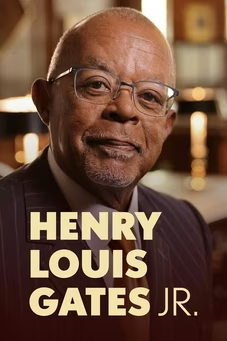
Henry Louis Gates, Jr. maps the Caribbean heritage of Liza Colón-Zayas and Delroy Lindo.
Henry Louis Gates, Jr. explores the Caribbean heritage of actors Liza Colón-Zayas and Delroy Lindo—meeting women and men who crisscrossed the globe to help their families move forward, often taking enormous risks. Along the way, Delroy and Liza both gain a new understanding of the ancestors—enslaved and free—who laid the groundwork for their success.
From
Problems playing video? | Closed Captioning Feedback
Problems playing video? | Closed Captioning Feedback
Corporate support for Season 11 of FINDING YOUR ROOTS WITH HENRY LOUIS GATES, JR. is provided by Gilead Sciences, Inc., Ancestry® and Johnson & Johnson. Major support is provided by...
Support provided by:


Finding Your Roots
Caribbean Roots
Season 12 Episode 3 | 52m 9sVideo has Closed Captions
Henry Louis Gates, Jr. explores the Caribbean heritage of actors Liza Colón-Zayas and Delroy Lindo—meeting women and men who crisscrossed the globe to help their families move forward, often taking enormous risks. Along the way, Delroy and Liza both gain a new understanding of the ancestors—enslaved and free—who laid the groundwork for their success.
From
Problems playing video? | Closed Captioning Feedback
How to Watch Finding Your Roots
Finding Your Roots is available to stream on pbs.org and the free PBS App, available on iPhone, Apple TV, Android TV, Android smartphones, Amazon Fire TV, Amazon Fire Tablet, Roku, Samsung Smart TV, and Vizio.
Buy Now
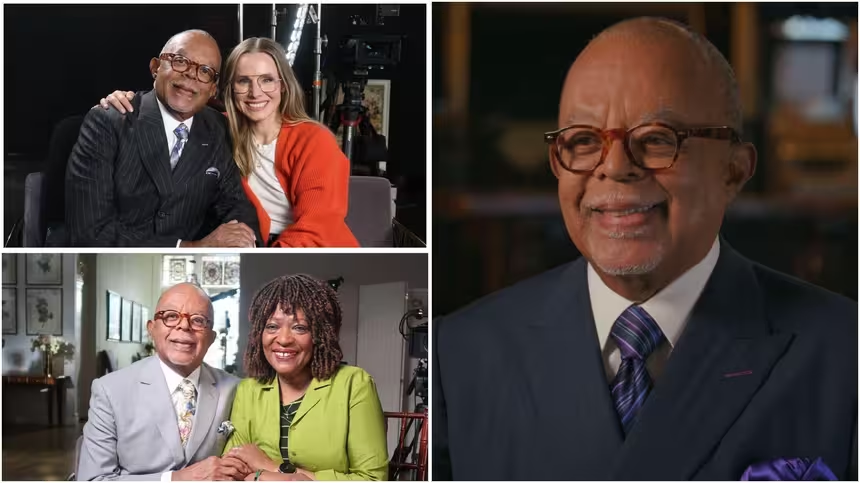
Explore More Finding Your Roots
A new season of Finding Your Roots is premiering January 7th! Stream now past episodes and tune in to PBS on Tuesdays at 8/7 for all-new episodes as renowned scholar Dr. Henry Louis Gates, Jr. guides influential guests into their roots, uncovering deep secrets, hidden identities and lost ancestors.Providing Support for PBS.org
Learn Moreabout PBS online sponsorshipGATES: I'm Henry Louis Gates Jr.
Welcome to "Finding Your Roots."
In this episode, we'll meet Delroy Lindo and Liza Colón-Zayas, two actors hoping to learn secrets that their ancestors tried to hide.
LINDO: Pieces of myself are being filled in.
GATES: Mm-hmm.
LINDO: If this is a, a jigsaw, you know, this is another piece in the jigsaw.
COLÓN-ZAYAS: I want the next generation to know that we didn't just emerge out of the South Bronx, you know, that we have, we have a long, rich history.
GATES: To uncover their roots, we've used every tool available.
Genealogists comb through paper trails, stretching back hundreds of years.
LINDO: Get outta here.
GATES: While DNA experts utilize the latest advances in genetic analysis to reveal secrets that have lain hidden for generations.
COLÓN-ZAYAS: This is epic.
GATES: And we've compiled it all into a “Book of Life,” a record of everything we found.
LINDO: That fascinates the hell outta me.
GATES: Did you ever think you would learn the name of an enslaved ancestor?
COLÓN-ZAYAS: I, I thought I might, I thought I might, but I, it breaks my heart, and I'm crying, not because it's a total shock to me... GATES: Mm-hmm.
COLÓN-ZAYAS: It's because now there is a name to this person.
GATES: My two guests have deep roots in Jamaica and Puerto Rico, but their parents left those roots behind and rarely spoke about them, burying their family stories in the past.
In this episode, those stories will be unearthed, forever altering how Delroy and Liza see themselves.
(theme music playing).
♪ ♪ (book closes).
♪ ♪ (overlapping chatter).
GATES: Delroy Lindo may seem like a tough guy, but the imposing actor with the ice-cold stare is nothing like the fierce men he's portrayed on screen.
In fact, in person, Delroy is warm, thoughtful, and profoundly sensitive.
And when he tells his story, you understand why.
Delroy was born in England, the son of Jamaican immigrants.
He was raised in London by his mother, a nurse who struggled mightily in a place where she was made to feel like an outsider.
As the only Black child in his elementary school, Delroy often felt like an outsider himself.
But when he was cast as one of the wise men in the school's Christmas pageant, his life was transformed.
LINDO: I was in the nativity play as a 5-year-old when I played Balthazar.
GATES: Yeah, the wise man of color.
(laughs).
LINDO: And, um, I, um, but what it was, and this is what I've learned relatively recently, it was not the, the, the aspect of performing, even though that was wonderful.
What it was, was the teacher who was, um, directing the pageant, the play, singled me out as an example of what to do.
GATES: Huh.
LINDO: “Watch what Delroy does”" GATES: Uh-huh.
LINDO: "Do it like that."
What she was talking about was projecting... GATES: Uh-huh.
LINDO: But she didn't say that, she... just the way that I was saying the lines.
GATES: Right.
LINDO: And she used me as an example, and I believe that was an, an affirmation for me.
GATES: Yeah.
LINDO: That was an affirmation.
And that's when a, a dime dropped, that, that I was affirmed in a very singular way.
GATES: That teacher put Delroy on the path he's still following today, but the journey would be a circuitous one.
Over the next few years, Delroy and his mother would move from England to Canada and then finally to the United States, where Delroy would begin to study acting in earnest.
But it would take him over a decade to find success, much to his mother's dismay.
LINDO: One of the things that my mom had a really, really, really hard time understanding, and I, and I, and I understand that, okay, you go and you work in the theater, and you, you, you, you go and you, you, you rehearse, you work for eight weeks, you rehearse for four weeks, and then you perform for, for, for another four weeks... GATES: And then you're unemployed.
And she'd go, “What's this about?” LINDO: “What do you mean?
You maybe get a job, and then you don't have a job.” GATES: Mm-hmm.
LINDO: “And, and what happens in between.” GATES: Mm-hmm.
LINDO: A foreign con, an alien concept.
GATES: Yeah, but most people don't understand that.
LINDO: This is true.
GATES: Most parents don't, you know?
LINDO: No, this is true.
GATES: Yeah.
LINDO: But, but for, for the Caribbean and I... GATES: Mm-hmm.
LINDO: Not, not necessarily just the Caribbean, um, people, but for any, any, any, anybody who comes from a generation for whom education was everything.
GATES: Everything.
LINDO: Everything.
And then once you got your education, you found a solid occupation... GATES: Mm-hmm.
LINDO: That was going to allow you to, to, to make your way through life.
GATES: Right.
LINDO: And acting was not it.
GATES: So, you, did you break her heart... LINDO: Yes.
GATES: When you said, "I'm going to be an actor?
LINDO: Yes.
GATES: And she said, “What's wrong with you?” LINDO: I, I could, yes, all of the above.
GATES: Mm-hmm.
LINDO: I could have just as well have said, “I'm going to the moon, Ma.” (laughter).
GATES: Delroy eventually put his mother's fears to rest.
In 1992, when he was 40 years old, he landed a role as a Harlem gangster in Spike Lee's masterpiece, "Malcolm X," and found fame.
He's worked almost constantly ever since, while also navigating an industry that can be fickle, particularly towards actors of color.
But looking back on all he's achieved, Delroy's greatest pride is a simple one: he stayed true to his craft and true to himself.
LINDO: I'm proudest of the fact that the relationship between art and commerce, even though I have made missteps for sure, um, but it hasn't, um, it hasn't destroyed me.
I've continued to, to work, and I'm, and I'm really proud of that.
GATES: If you could go back to the nativity play and pull Balthazar aside, what would you say to your young self?
LINDO: If there is anything that you can do, if there's anything else that you can do and be happy, do that.
GATES: Right.
LINDO: No, I'm serious.
GATES: Mm-hmm.
LINDO: If you genuinely feel in making this decision to become an actor, that this is your destiny for what, however you interpret that, don't let anybody stop you.
GATES: Mm-hmm.
LINDO: But for God's sake, if there's anything else you can do and be happy, do that.
GATES: Why?
LINDO: It's a beautiful craft.
GATES: Yeah.
LINDO: Um, but you gotta know what you're getting into.
(laughter).
GATES: My second guest is Emmy Award-winning actor, Liza Colón-Zayas, famed for her star turn in Hulu's hit series "The Bear."
Much like Delroy, Liza grew up far from the spotlight.
Both of her parents are Puerto Rican, and Liza was raised in a housing project in New York City at a time when there were very few Latinos in Hollywood.
But even so, that did not stop her from dreaming.
As a child watching television, she became enthralled with "The Partridge Family" and hatched a plan to change her life, a plan that her older brothers would thwart.
But only after Liza had taken it to an extreme.
COLÓN-ZAYAS: And I had the biggest crush on Keith Partridge, but I wanted to be one of the siblings, which is problematic, I don't know.
(laughter).
But it's like, I wanna live in a multicolored bus and play the tambourine and be with, you know, and she's a single mom, they're, they're doing good.
It seemed like everything happy was happening in California with the sunshine and the palm trees, and everything look great.
So, I wrote this whole letter that I was gonna run away.
I'm going to replace the little girl, Tracy, who sang, and you know, this is what I'm gonna do, okay?
I don't know, I, my plan was like to take a taxi or something, I don't know.
But my, I, I think my one, I don't know which one, one of them found the letter and opened it, and just, they began to have the biggest laugh.
The hugest laugh of my crush, of my, of this idea.
And then I was like, “Pfft, later for you.” (laughter).
GATES: As it turns out, Liza would not be able to hold back her dreams much longer.
After high school, she enrolled at the University of Albany as a business major, but soon switched to acting.
Was there a, a, a click moment, a certain moment when you said, “I'm not gonna be an accountant?” COLÓN-ZAYAS: No.
GATES: “I am going on the stage.” COLÓN-ZAYAS: Yeah, my boyfriend at the time, well-meaning, please, I just like, he was like, “Yeah, I don't think anybody wants to see a chubby Latina on TV.” GATES: That's terrible.
COLÓN-ZAYAS: But he meant well.
GATES: Mm-hmm.
COLÓN-ZAYAS: And, and... GATES: And he was Latino?
COLÓN-ZAYAS: Yeah, he's Puerto Rican, yep, yep, professional.
And he was like, I want us to be a family that, you know, has, you know, combined income that's really good and live in the suburbs, that he had these dreams, and I've, as a person already feeling unworthy... GATES: Mm-hmm.
COLÓN-ZAYAS: ...of anything good.
You know, it's like, okay, so maybe I'll, I don't know, I'll, I'll study economics.
GATES: Mm-hmm.
COLÓN-ZAYAS: But then I saw that there was a, a, an original piece being performed in Albany, written and created by the, uh, an indigenous women.
GATES: Hmm.
COLÓN-ZAYAS: And I went and I watched it, and I was like, that's it, I'm gonna do it.
GATES: Liza has never regretted that decision, though it wasn't easy to make it pay off.
After college, she returned to New York City, moved in with her mother, and set out to find work.
She started slowly with small roles in off-Broadway plays.
But everything changed in 1995 when she wrote, produced, and starred in "Sistah Supreme."
A one-woman show, based on her own childhood.
The show took Liza's career to the next level, but more importantly, it helped her understand how she wanted to represent herself and her people.
COLÓN-ZAYAS: I don't wanna play sanitized characters.
GATES: Mm-hmm.
COLÓN-ZAYAS: That doesn't feel authentic to me or useful.
Um, I like messy characters.
GATES: Mm-hmm.
COLÓN-ZAYAS: And of course, I'm who I am, so she's gonna be Latina, she's gonna be Afro-Latina, but as long as there's humanity and people wanna see the journey, um, and there's nuance, there's layers.
As long as I can bring that to the surface... GATES: Mm-hmm.
COLÓN-ZAYAS: You know, at the very least, um, if I can reflect our strength... GATES: Mm-hmm.
COLÓN-ZAYAS: And our value, our worth, then no matter how messy it gets, I, that's what I wanna, I wanna show, you know, we survive.
GATES: My guests share a common thread; both grew up focused on their careers with very little knowledge of their family trees.
It was time for that to change.
I started with Delroy and with his mother, Enna Moncrieffe.
Enna was born in Jamaica, but in 1951, when she was 37 years old, she left her home behind and boarded a ship for England seeking work as a nurse.
It would be the first of many journeys to come.
Did she ever talk about what inspired her to make the move?
LINDO: No, she never talked to me about it at all.
I, I, I knew, I knew, um, that it was career-oriented.
GATES: Mm-hmm.
LINDO: Um, um, but my mom never talked to me about it.
GATES: Do you think that she liked England?
LINDO: No.
GATES: No?
Why not?
LINDO: I, I just think, uh, it was too, um, too difficult, too racist, too confining.
GATES: Mm-hmm.
LINDO: Too... debilitating.
GATES: Mm-hmm.
LINDO: And this is one of the things that I really respect about my mom and I, my re, the respect that I have for my mom has been, has increased, um, retrospectively because I just feel like my mom saw the handwriting on the wall in England.
GATES: Mm-hmm.
LINDO: The United Kingdom, and got the hell out.
GATES: Right.
And it was a good thing.
LINDO: And it was a good thing.
GATES: Getting out of England may have been a good thing, but it wasn't easy.
In 1958, when Delroy was five years old, his mother sent him to live with another family in London and set off for Canada, where nurses were in high demand.
She and Delroy would be separated for almost seven years.
We uncovered the passenger list of the Arcadia, the ship that took Enna to Canada.
It offered Delroy a glimpse of his mother at that pivotal moment.
LINDO: Yep.
GATES: What's it like to see that?
LINDO: On some... (clears throat).
...on some level, it's kind of mind-blowing because seeing this is just, um, profoundly affirming for things, for feelings that I have, that I have and have had about my mom's history and about how my mom lived her life.
And here is the tangible evidence of that.
And I'm not, I'm not really, I'm not sure why it's, it's moving, it's, it's, it's, um, emotionally impactful.
But, uh, it is.
GATES: Ultimately, Enna was able to make a home for herself and bring Delroy from London to Canada.
But along the way, like many immigrants, she chose to block out her past.
And Delroy's roots in Jamaica were a blank slate.
We set out to fill them in, beginning with Enna's birth record, which contains a wealth of information about her family.
We suspect that the informant listed here, a man named George Moncrieffe, was a relative of Enna's father, Delroy's grandfather, Henry Moncrieffe.
And the name listed here, Ida Laing, is Enna's mother, Delroy's grandmother.
Ever heard of her?
LINDO: No.
Wow.
GATES: And you notice something else about that record?
LINDO: "Name of Father..." blank.
GATES: So, you know what that means?
LINDO: What?
GATES: We suspect that your grandparents, Henry and Ida, weren't married at the time your mother was born.
LINDO: Yes, yes, right.
GATES: And in fact, the register clerks in Jamaica followed an old English law that if the parents were not married, the father's name would not be listed on the birth certificate.
LINDO: Blank.
GATES: Yeah, that was the signal.
LINDO: Yep, makes sense.
GATES: Did your mother ever talk about this?
LINDO: Not at all.
GATES: Henry and Ida had two children together, but chose not to marry.
And while we don't know anything about the nature of their relationship, we do know that it didn't last long, because records show that in 1928, Henry married a woman named Letitia Beckford.
LINDO: So, this is, this is my grandfather.
GATES: Yes.
LINDO: Finally marrying somebody else.
GATES: Someone else, yeah.
That's your grandfather, Henry, getting married to someone other than your grandmother, Ida.
LINDO: Other than the, the woman he's had these kids with.
GATES: Yeah.
LINDO: Right, gotcha.
GATES: And your mom was 14 years old at the time, when her father married another woman.
LINDO: I, I don't know what the, I, I, I didn't know this, but it all makes sense.
GATES: Mm-hmm.
LINDO: And oh, man.
Um... it's cons, not the specifics of my grandfather marrying another woman, not the specifics of that, per se, but it's consistent with some things that my aunt told me about certain things that had happened that impacted them as children.
GATES: Mm-hmm, hmm.
LINDO: And that some of these things that happened when they were children had impacted my mother very negatively, harshly.
GATES: Hmm.
LINDO: Now, I don't know if it's this per se, but it's just consistent with... ...an impression that one has... an impression that one has, that gradually becomes less impressionistic.
GATES: Mm-hmm.
LINDO: And more specific.
GATES: Mm-hmm.
LINDO: It's as if figures are emerging through a fog.
GATES: We now began to follow the roots of Delroy's grandmother, Ida, tracking back to her grandparents, Delroy's great-great -grandparents, a couple named James Laing and Margaret Campbell.
We believe they both were born in Jamaica in the early 1800s, when the island was one of Great Britain's richest colonies with an economy powered by slavery.
Searching for traces of their lives, we uncovered a registry of Jamaica's enslaved population from the year 1826.
It lists the names of thousands of enslaved people, including several hundred owned by a sugar planter who shared the surname of Delroy's ancestors, “Laing.” And one of these names stood out.
LINDO: Margaret Campbell.
Color: Negro.
Age, two.
African or Creole, Creole.
GATES: So, we have gone back into the bowels of slavery and found your ancestor by name and found the name of the White man who owned her.
LINDO: Owned her.
GATES: Yeah.
LINDO: And that's where the Laing name came from.
GATES: That's right, you got it.
She was held at the Goshen Estate.
We've marked its location right there.
LINDO: Goshen, mm-hmm.
GATES: You've been anywhere near there?
LINDO: Nope.
GATES: You gonna go there now?
LINDO: Absolutely.
GATES: Because you got roots there.
LINDO: Absolutely, absolutely.
GATES: Margaret was likely born on this estate in the early 1820s, and as we combed through the estate's archives, we made a precious discovery.
Margaret's mother, a woman named Louisa Thomas, is listed by name on multiple documents.
Louisa is Delroy's third great-grandmother.
She was born in the year 1797, meaning that Delroy's maternal roots can be traced back to the 18th century in a continuous paper trail.
What's it been like for you to learn about your mother's family in so much depth?
LINDO: It's been... elevating.
It's been elevating.
And if... my response, you know, I, it's, it's, it's, um, if my response has brevity, it's just because I, I can't, I can't articulate every, I can't articulate.
GATES: Of course.
LINDO: But if I, I feel like I'm a, well, a comet does that, but I feel like I'm a comet in reverse.
GATES: What would your mom have made of this?
LINDO: I, I'm sure my mother would've appreciated this man.
I'm, I'm, I, I 'cause it's, you know, it's, it's, it's, it's healing.
GATES: Yeah, it is.
LINDO: And if, if anybody needed to be healed, it was my mom.
GATES: Mm-hmm.
LINDO: And myself, yes.
GATES: Mm-hmm.
LINDO: But my mom needed healing.
My mom needed a laying on of hands.
My mom needed a laying, laying on of hands that she didn't even know she needed.
GATES: Like Delroy, Liza Colón-Zayas grew up very close to her mother, but came to me knowing little about her maternal roots.
We started one generation back with Liza's grandfather, Pablo Marrero Almestica.
Pablo was born in Puerto Rico in 1905.
As a young man, he spent years struggling to support himself, moving from job to job in an economy that had been devastated by the Great Depression.
Finally, when he was in his 30s already with a wife and children, he joined the United States Merchant Marines, a decision that would change his life.
COLÓN-ZAYAS: Arriving at New York, name in full Pablo M. Almestica, fire and water tender.
GATES: Pablo M. Almestica.
So, you know what you're looking at?
COLÓN-ZAYAS: Yes.
GATES: There's your grandfather working on a ship called The S.S.
Black Eagle.
COLÓN-ZAYAS: Yeah.
GATES: What's it like to see that ship?
COLÓN-ZAYAS: I never saw full pictures of him on the ship, I would see, like, there were pictures of him down in the basement working on machines, or in his little bunk, on, you know, on deck posing.
But I never saw... Wow, the size of this.
(laughter).
(sighs).
GATES: What have you heard about his job in the Merchant Marines?
COLÓN-ZAYAS: I don't, I never understood it.
Um, I never really understood what he did.
GATES: Well, as you read, he was a fireman and water tender, which means that he was running and maintaining the ship's boilers.
So, it was hot and very dirty work.
And when he was on a job, he'd ship out for days or even months at a time.
Uh, can you imagine living and working on a ship like that for months?
Mm-mm.
COLÓN-ZAYAS: He never wanted to go to the beach after they went back to Puerto Rico.
GATES: Yeah.
COLÓN-ZAYAS: I wanted to go; he never wanted to see the beach again.
GATES: Though he may not have enjoyed being on the water, Pablo stuck with the Merchant Marines, likely because they paid well and brought the stability, he'd been seeking for so long.
Even so, the job was very hard on his family.
When he wasn't on his ship, Pablo was rarely able to return to Puerto Rico as his base was in New York City.
The situation became so stressful that Liza's grandmother eventually decided to join him in New York with their children.
Did you know that?
COLÓN-ZAYAS: Uh, I knew that, yeah, uh, my mom didn't really know her father until she was 11.
GATES: Mm-hmm.
COLÓN-ZAYAS: 'Cause he had been away at sea... GATES: Yeah.
COLÓN-ZAYAS: All of those years.
So, she was confused as to who this man was and telling her what to do and all.
GATES: “Don't you have a ship to catch?” (laughter) COLÓN-ZAYAS: Yes.
GATES: That had to have been hard on your grandmother.
COLÓN-ZAYAS: Yeah, she was trying to... GATES: Mm.
COLÓN-ZAYAS: Um... GATES: Mm-hmm.
COLÓN-ZAYAS: Um, just survive, uh, as a, basically a single mom in a country, she didn't know the language at all.
GATES: Oh my God, can you imagine?
COLÓN-ZAYAS: Very strong.
Um, and she kept it, you know, so much of it inside.
GATES: We now turn to Liza's, deeper roots and discovered something surprising in the marriage record of her grandfather's father, a man named Pablo Marrero Adolfo.
COLÓN-ZAYAS: Natural son of Juliana.
GATES: Natural son of Juliana.
Do you know what that means?
Natural son?
COLÓN-ZAYAS: No, I assume gave birth to him?
GATES: It means his mother was not married at the time of his birth.
There were two categories, legitimate or natural.
And natural means the mother was not married to the father of the child.
COLÓN-ZAYAS: Wow.
GATES: So, so your grandfather's father was, as we say, born out of wedlock.
Did you have any idea?
COLÓN-ZAYAS: No.
This is a wild ride.
GATES: It is.
COLÓN-ZAYAS: This is, wow.
GATES: This story was about to take a somber turn.
Pablo's mother, Juliana, was not only unmarried, she was also enslaved.
Records show that she was born into slavery on the island of Guadalupe.
And then, as a young woman brought to Puerto Rico to work in the household of a sugar planter.
Though Liza knew that slavery had played a significant role in Puerto Rico's past, seeing it connected directly to her family, with such specificity, was profoundly emotional.
Did you ever think that you would learn the name of an enslaved ancestor?
COLÓN-ZAYAS: I, I thought I might, thought I might, but I, it breaks my heart, and I'm crying.
GATES: Mm-hmm.
COLÓN-ZAYAS: Not because it's a total shock to me.
GATES: Mm-hmm.
COLÓN-ZAYAS: It's because now there is a name to this person.
GATES: Oh, yeah.
COLÓN-ZAYAS: Ugh.
GATES: We had one more name to share with Liza.
The name of the man who fathered Juliana's son, he was called Amedae Marrero.
And this was especially meaningful to Liza because Amedae was a nickname that her grandfather chose for himself and used throughout his life.
COLÓN-ZAYAS: That's where he got the nickname?
GATES: That's where he got the nickname.
And we also suspect that, like Juliana, Amadae may also have been enslaved.
We just can't prove it.
‘Cause remember she's enslaved.
COLÓN-ZAYAS: Yeah.
GATES: And there is your grandfather... COLÓN-ZAYAS: Wow.
GATES: Bonding to this family tradition, bonding, your grandfather is bonding to his grandfather.
COLÓN-ZAYAS: So that would make Don Amadae my great-great... GATES: Great-great-grandfather.
COLÓN-ZAYAS: It's wild.
That's wild.
GATES: How do you think your mother will react when she finds out about all this?
(laughter).
COLÓN-ZAYAS: Yeah, I gotta come over with a bottle of, uh, coquito, and then we're gonna have to sit it, uh, her whole reality is gonna get shaken.
GATES: We'd already explored the secrets hidden in Delroy Lindo's mother's family tree.
Now, we encountered a man whose entire life was shrouded in secrets.
Delroy's own father, Ivan Lindo, like Delroy's mother, Ivan, immigrated to England from Jamaica.
But this shared experience did not bind Delroy's parents together.
To the contrary, Delroy told me that he only saw his father a few times over the course of his life, and that their interactions were almost always painful.
Leaving Delroy, even now, still trying to make sense of Ivan.
LINDO: There are a couple of possibilities as to why he was the way he was.
GATES: Mm-hmm.
LINDO: One possibility is that he just was, um, sociopath who couldn't do any better.
(laughter).
The other possibility, the other possibility is, um, that, and this is a, this is something we're all aware of, as, as, as, as, as Black men, um, he just was beaten and battered.
GATES: Sure.
LINDO: And, and devalued.
GATES: Right.
LINDO: And told he was nothing.
GATES: Mm-hmm.
LINDO: Um, constantly, despite the fact that you look at this photograph and you see he had a sense of himself.
GATES: Yeah, he's a handsome man.
LINDO: Yeah.
GATES: Yeah.
LINDO: And despite whatever his sense of himself was, um, there was no outlet for that.
GATES: Yeah.
LINDO: And so, you know, how can one be constantly knocked around and not be impacted by that?
GATES: That's right.
LINDO: And I think that's part of, uh, I think that's a significant part of what happened with him.
Um, and coupled with whatever his natural tendencies were... GATES: Uh-huh.
LINDO: It made for an individual who certainly was not as caring toward my mom... GATES: Right.
LINDO: ...as he could have been and... GATES: Mm-hmm.
Or to his son.
LINDO: ...Or to me.
GATES: Ivan would prove to be as complicated to our researchers as he was to Delroy, raising many questions that we could not fully answer.
The first concerns his name; there are almost no records of anyone named Ivan Lindo, either in Jamaica or England, that matched Delroy's father.
The reason, at some point, likely in his youth, Ivan began to call himself Austin Stanford.
Did he ever say why?
Or do you know why he did that?
LINDO: No, and no.
I have a theory, but no, I do not know why he changed his name, as I don't know that it was ever legal.
GATES: Yeah, there is no, we have found no record of him that he did it officially.
LINDO: Yeah, yeah.
GATES: Yeah.
LINDO: Um, but I think, I think I, I, I surmise that, um, he did this because it was a better representation.
It sounds more elegant.
GATES: Mm-hmm.
LINDO: And I... GATES: Austin Stanford.
LINDO: Austin Stanford.
GATES: Like Austin Healey, one of my favorite cars.
LINDO: It has a... Yeah, yeah, yeah.
It has a, it has a, it has a certain ring to it, and I think he, he probably, uh, took that on as a, as a way of, um, presenting himself in a more elegant fashion.
GATES: When you saw him later in life, was he Austin?
LINDO: Yeah, he was Austin, the whole, the whole, uh, uh, time that I knew him.
GATES: Oh, okay.
LINDO: I, I knew as my father, I never knew him as Ivan Lindo.
GATES: Ah.
LINDO: I always knew him as Austin Stanford.
GATES: Gotcha.
Well, knowing that your dad used that name proved to be very helpful to our researchers.
Let me show you what we, what I mean.
LINDO: Okay.
GATES: Please turn the page.
LINDO: Okay.
Whoa.
GATES: This is a British electoral role, one of dozens that we found listing Austin Stanford, or some variant of that name.
Taken together, these roles show that Delroy's father moved around frequently.
Records also show that in June of 1955, Delroy's father chose to do something that he had not done with Delroy's mother.
He got married LINDO: Name and surname, Austin Ivan Stanford.
Age, 34.
Rank or profession, machine hand.
Residence at the time of marriage, 56 Inch Mary Road, Catford.
Name and surname, Ethlen Med Green.
GATES: This is the marriage record for your father under the name Austin Ivan Stanford.
LINDO: Yep.
This is, this is par for the course from my father.
Um, and as much what I, what I mean by that is that, um, it doesn't surprise me that he, uh, he wasn't thinking about me, he wasn't thinking about my mom.
Um, and so, uh, I'm not surprised that he, he got married.
Um, actually, this is before my third birthday.
GATES: Mm.
LINDO: It doesn't surprise me.
GATES: Wow.
LINDO: It's unfortunate.
GATES: After his marriage, Delroy's father continued his peripatetic ways, moving three times in four years before briefly settling down in the Lewisham neighborhood of London.
Delroy told me that his father then moved to Toronto sometime in the 1970s, but we couldn't find any record of his journey.
In fact, by that time, Ivan had completely vanished from the paper trail.
He just disappears.
And Delroy, not one place have we been able to find... LINDO: Any evidence... GATES: Under either his two names.
Unless he picked a third name that we don't know.
LINDO: You know what?
I have no idea.
But once again, that doesn't necessarily surprise me about my, my dad.
Man, we hired researchers in England, in Canada, in Jamaica.
They went over every single archive that they could find.
We even had a conversation about it.
And, you know, 'cause I didn't wanna disappoint you, I wanted to pull a rabbit outta the hat.
And our head genetic genealogist said, “We're not gonna find this guy”" LINDO: Right.
GATES: “We have looked everywhere; it will be a miracle.” LINDO: So, look, this... A, I'm absolutely not, um, surprised or disappointed.
I'm not disappointed.
I'm also not surprised because he, he disappeared, man.
He has, he had a habit of just as he... (laughter).
Man, just as he had a habit of not showing up for me in my life, not showing up for my mom in her life, flitting in and out randomly, it, it, it does not surprise me that he, he randomly shows up in Toronto and nobody, nobody can figure out how he got there.
GATES: No.
And there's, and our, we are expert on tracking of people.
LINDO: I hear you.
GATES: We tried to learn more about Delroy's father and uncovered his death certificate, which reveals he passed away in Jamaica in 1996.
But unfortunately, after that, we hit brick wall after brick wall.
So, when our team built out Delroy's family tree, his mother's side stretched back into the 1700s, while his father's contained just two names.
A stark contrast that nevertheless held meaning to Delroy.
LINDO: So, to look at this and to have this, and to have this is kind of in keeping with, unfortunately, what my experience was.
GATES: Yeah, I'm sorry.
LINDO: No, no, no, no, no.
I don't say that from a place of disappointment.
I say that it's, it's more of a kind of a pragmatic assessment.
GATES: Right.
LINDO: Right?
Um, and, and also, it's curious as hell to me that you say that none of your researchers could find any evidence of how he got from the United Kingdom to Canada.
That fascinates the hell outta me.
GATES: Yeah, because the shipping records, passenger list, you know, we found them for everybody else.
LINDO: Right, but that was, that was my dad, man.
GATES: Yeah.
LINDO: This, this, this, um, this notion that I have of him, of, of, I'm not, I, I will not say a non-person, but a shadowy person.
GATES: Mm-hmm.
LINDO: And I, and I don't, I don't, I'm not using that as pejorative.
GATES: Mm-hmm.
LINDO: I, I use it as a, as a physical, he's someplace between being real, which I know he was, and a, and an app-apparition.
GATES: Yeah.
LINDO: And in retrospect, I'm sure that none of his dreams came true.
GATES: Mm-hmm.
LINDO: None of his aspirations for himself were fulfilled, and that's... GATES: That's so sad.
LINDO: Yeah, yeah, it is.
GATES: We'd already traced Liza Colón-Zayas' maternal roots from New York to Puerto Rico.
Now turning to her father's ancestry, we'd followed a similar path, only to end up in a very different place.
The story begins with Liza's grandmother, Julia Irizarry, or as her family called her, “The Little General.” Julia was born in Puerto Rico in 1908, then moved to New York as a teenager.
Liza knew that she had had a dramatic life, but Julia herself rarely spoke about it.
Was she a storyteller?
COLÓN-ZAYAS: Not really.
GATES: No?
COLÓN-ZAYAS: Sometimes if I asked direct questions, um, she would, and then, uh, uh, like, you know, I asked her like, “Oh, what was it like when you got here?” And or, you know, she told me like the wages, um, what she did.
And then I think I tried to ask about her parents, and she was like, “Why are you asking so many questions?” GATES: End of conversation.
COLÓN-ZAYAS: Yeah.
GATES: Well, I'm gonna show you what we found.
Could you please turn the page?
We're back already 64 years.
This is a record from the City Clerk's office in New York City dated November 19th, 1960.
Would you please read that transcribed section?
COLÓN-ZAYAS: From the bride, Julia Irizarry.
Number of times previously married, once.
I knew it!
Full name of former husband, Pedro Mangual.
Wow.
GATES: This record indicates that Liza's grandfather was not Julia's first husband.
Digging deeper, we discovered that she married for the first time when she was just 17, to a man named Pedro Mangual.
Within three years, the couple had had two children together, but their happiness didn't last.
In December of 1928, their youngest child passed away when he was just four months old.
COLÓN-ZAYAS: I didn't know this at all.
Wow.
No wonder she didn't wanna talk about these things.
GATES: Yeah, she never talked about it?
Mm.
How do you think that affected her?
COLÓN-ZAYAS: Probably contributed to the title, "Little General."
Where she had to armor up.
GATES: Yeah.
COLÓN-ZAYAS: And be strong and carry on, and.
GATES: I would think so.
COLÓN-ZAYAS: Oh my God.
GATES: Unfortunately, Julia would have to carry on through a great deal more heartache.
Four years after losing her child, her husband died of tuberculosis.
And though Julia would remarry and start a new family with Liza's grandfather, another cruel blow lay ahead.
When the United States entered World War II, Julia's eldest son, Pedro, volunteered to serve.
He would be killed fighting Japanese forces in the Pacific.
Pedro is Liza's half-uncle.
She'd heard about his fate, but never seen any evidence of it until now.
COLÓN-ZAYAS: “From Commandant of the Marine Corps.
To Mrs.
Julia Colón, mother.
Deeply regret to inform you that your son, Private First Class Pedro H. Mangual, was killed in action.
10th of April, 1945, at Okinawa Island.” (crying).
I'm glad to see it on paper.
GATES: Mm.
COLÓN-ZAYAS: I saw my father once tell this story after many scotches.
Which he didn't do often... GATES: Mm-hmm.
COLÓN-ZAYAS: But I'm grateful to see it recorded.
GATES: He was just 18 years old.
The irony is he lied about his age to get in.
He was only 15 when he joined the Marines, shortly after Pearl Harbor.
COLÓN-ZAYAS: Wow, 15.
GATES: I know.
COLÓN-ZAYAS: So, Julia, is just being buffeted by fate.
GATES: That's right.
Following her son's death, Julia received a letter from the Marine Corps informing her that Pedro's remains had been interred on Okinawa, the island where he was killed.
In response, Julia made a series of simple yet agonizing requests.
COLÓN-ZAYAS: “Dear Sir, in regard to your letter dated May 14th, 1945, in report to my son's death, PFC, Pedro H. Mangual, please, I want to ask you a favor for my sake.
Please do not have his clothes sent back to me.
Please do not send nothing home.
I also have to ask you that as my son gave his life for his country and he joined the Marines of his own free will, after this war is over, I would like to have his remains brought back to the United States.
I am asking you this favor, as his mother.
Thank you.
I re, I remain very truly yours, Julia Colón.” GATES: That is just so heartbreaking when I read that.
COLÓN-ZAYAS: Wow.
You know, she just, she always just seemed so solid and steady.
GATES: Julia's wishes ultimately were granted.
After the war; her son's remains were transferred to a military cemetery in the United States.
What's more, in 1948, she received yet another letter from the Marine Corps, this one detailing the honors that Pedro was to receive posthumously.
COLÓN-ZAYAS: And a ribbon bar with one star and Victory medal World War II.
Wow, Yeah, yeah.
GATES: So, you know what that means?
COLÓN-ZAYAS: Yeah.
GATES: Pedro and his unit received multiple awards, including the Presidential Unit Citation, and they received this award for their quote-unquote extraordinary heroism in fighting at Okinawa.
What's it like to see that?
COLÓN-ZAYAS: You know, my people fight hard.
We bring it all, and this is more proof, and I'm so relieved... ...that he was acknowledged.
GATES: There is a final beat to this story, a far happier one.
When we set out to trace Julia's roots, we found a treasure trove of documents.
They allowed us to go back over 200 years and introduce Liza to her fourth great-grandparents, who married in Puerto Rico in 1799.
COLÓN-ZAYAS: Wow.
GATES: I have to ask you... COLÓN-ZAYAS: Wow.
GATES: What is it like learning this?
COLÓN-ZAYAS: But I'm grateful for this, I'm so like, yeah, my people go back from seven, ‘til 1799.
Easy.
(laughter).
GATES: What do you think your father would've felt?
Because after all, these are his ancestors.
COLÓN-ZAYAS: He would just be grunting.
That's what he did when he was in... (grunts).
He'd be doing a lot of that?
GATES: Yeah, well, I got news for you when I saw this, I went... (grunts).
...too.
(laughter).
The paper trail had now run out for Liza and Delroy, but there were surprises still to come when we compared their DNA to that of others who've been in the series, we found a match for each of them.
Evidence within their own chromosomes of distant cousins that they never knew they had.
For Delroy, this meant a new connection to an old friend.
You know LeVar Burton?
LINDO: Yes, I do.
GATES: That is your DNA cousin.
LINDO: Wow.
GATES: You and LeVar share a long, identical stretch of DNA on your 16th chromosome.
That means you have a distant common ancestor somewhere on your family tree.
LINDO: Some... Does he know that?
GATES: No.
LINDO: No, because he, you hadn't done me when you did him.
GATES: That's right, yeah.
LINDO: Wow.
GATES: Isn't that cool?
LINDO: That is.
GATES: And he would love to know that.
LINDO: That's way cool.
GATES: Liza, too, was about to discover that she has a new relative among her friends.
Turn the page and meet your cousin.
COLÓN-ZAYAS: Yes, I knew it.
(laughter).
GATES: Liza shares a long stretch of DNA with fellow actor and fellow Puerto Rican, Justina Machado.
COLÓN-ZAYAS: I love her so much.
We met a handful of times, and it's like we fall into each other.
GATES: Well, there you go, you got good reason.
COLÓN-ZAYAS: Hugs and laughter.
GATES: You can call her when you get home.
COLÓN-ZAYAS: Wow, this is a fantastic, thank you.
GATES: That's the end of our journey with Liza Colón-Zayas and Delroy Lindo.
Join me next time when we unlock the secrets of the past for new guests on another episode of "Finding Your Roots."
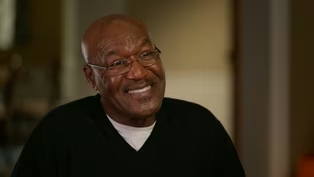
Delroy Lindo Traces His Jamaican Roots
Video has Closed Captions
Clip: S12 Ep3 | 4m 49s | Delroy Lindo dives deeper into his mother's ancestry. (4m 49s)
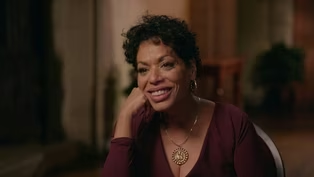
Liza Colón-Zayas Learns of Her Ancestor's Past
Video has Closed Captions
Clip: S12 Ep3 | 4m 4s | Liza discovers her maternal great-great grandmother's experience as an enslaved person. (4m 4s)
Providing Support for PBS.org
Learn Moreabout PBS online sponsorship
- History
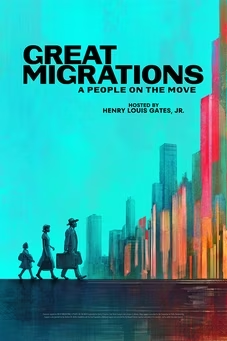
Great Migrations: A People on The Move
Great Migrations explores how a series of Black migrations have shaped America.



Support for PBS provided by:
Corporate support for Season 11 of FINDING YOUR ROOTS WITH HENRY LOUIS GATES, JR. is provided by Gilead Sciences, Inc., Ancestry® and Johnson & Johnson. Major support is provided by...