
David Brooks
Season 17 Episode 3 | 26m 46sVideo has Closed Captions
Alison sits down with journalist, columnist, and PBS News Hour mainstay, David Brooks.
Known for his insightful, and often humorous, consideration of American Society, David Brooks' writings are infused with genuine curiosity, and marked by the value he places on human connection. Alison caught up with the columnist and PBS News Hour mainstay when he visited Journalism students at Southern Adventist University.
Problems playing video? | Closed Captioning Feedback
Problems playing video? | Closed Captioning Feedback
The A List With Alison Lebovitz is a local public television program presented by WTCI PBS
David Brooks
Season 17 Episode 3 | 26m 46sVideo has Closed Captions
Known for his insightful, and often humorous, consideration of American Society, David Brooks' writings are infused with genuine curiosity, and marked by the value he places on human connection. Alison caught up with the columnist and PBS News Hour mainstay when he visited Journalism students at Southern Adventist University.
Problems playing video? | Closed Captioning Feedback
Where to Watch The A List With Alison Lebovitz
The A List With Alison Lebovitz is available to stream on pbs.org and the PBS app.
Providing Support for PBS.org
Learn Moreabout PBS online sponsorshipThis week on The A List, I talk with a man who has spent his storied career reflecting on the world around us.
And so politics gives you the illusion.
You'r filling the hole in your heart.
Because you seem to have a team, a community, you seem to have some, some righteousness, but you've just entered a world of of civil war.
And in my view, I you know, I cover politics like I care about it.
But if you're asking politics to fill your spiritual and emotional needs, you're asking more politics that it can absorb.
And I think if yo treat politics as your religion, you're going to wind up with a political world that's just a holy war.
You know, that's what we've got.
Join me as I talk with author and political commentator David Brooks.
Coming up next on The A List.
David Brooks has established himself as one of our country's foremost writers and commentators, known for his insightful and often humorous consideration of American society.
His writings are infused with genuine curiosity and marked by the valu he places on human connection.
David spent more than 20 years as an opinion columnist for The New York Times.
He is a writer for the Atlantic and devoted PBS NewsHour.
Viewers will know him a a regular political commentator.
I had the chance to sit dow with David while he was visiting Southern Adventist University, where he spoke wit journalism students and shared about his newest book, How to Know a Person The Art of Seeing Others Deeply and Being Deeply Seen.
Well, David, welcome to the A-list.
Happy to be part of the A-list.
Who couldn't.
Who would not be happy to be here.
Will you make us the A-list and also.
Welcom to Southern Adventist University and to their TV studio, whic I'm kind of thinking we may want to come back here more often because it's pretty sleek.
Having spent my life in PBS TV studios, I know they may look okay on TV, but they're pretty grungy.
Well this one we're thrilled to be in and thrilled to be on this campus.
And thrille that you will be in conversation with not only the students here, but the community about your book and your most recent book, and also just about the life that you've lived and the journey.
You seem to still be on.
I am believing I'm not the smartest person o earth, but I do grow changing.
So one of the nice moments in my life I was somehow with I was with my wife a couple of years ago, and we were looking back in old pictures of me before we were married.
And she looked at that guy and she said, well, I wouldn't have married that guy.
So I'm happy to progress, I hope.
Well, let's talk about that guy.
I'd love to know more about your childhood and just how you grew up, but also the curiosity that was aroused by I assume your parents initially, to really put you in the position of intellectual curiosity and writing about it and talking about it that you are now.
Well, my parents were academics, so there were a lot of books in the home.
And my grandfather, was a lawyer.
He really came from I grew up in lower Manhattan, in New York City.
And, if you started 14th Street and Second Avenue, for the folks who know New York and you walk a half mile south, you would have passed from my great grandfather, his butcher shop, my grandfather's law firm, where both my parents grew up, where I grew up and where my son lived until recently.
So five generations in one little neighborhood of New York City.
And so we had books all over the house.
And my grandfather, who really raised me, was just a great writer, and he admired writing.
And so when I was seven, I read a book called Paddington the Bear and decided at that moment I want to become a writer.
I didn't know what kind, but I'd been writing, every day since.
And when I lived in New York and elementary school, I was part I went to an Episcopal school, and I was in the choir.
And because it was New York the choir was about 30% Jewish.
And so we would sing the hymns, but we wouldn't sing the word Jesu to square it with our religion.
So the volume in the churc would go down and come back up and but so that was part of my formation, just to be in this big city right in the middle of New York in the 1960s and 70s.
And so that just fuels a lot of interest.
And then, I remember in high school, like a joke is true.
I wanted to date a woman named Bernice, and she didn't want to date me.
She dated some other guy.
And so I was thinking, what is she thinking?
I write way better than that guy.
So those are my values.
And then I went to the University of Chicago, which is a super intellectual place.
And so it was a straight shot, to being curious, which was a good thing.
It was not a straight shot toward being the most emotionally available person on the face of the earth.
I spent a lot of my early adulthood living up here in my head, and I've spent most of my lat adulthood trying to migrate down down here and be a little more emotionally available.
Was ther a moment when you realized this, or was there many moments where you realized it but just didn't do much about it?
I think the latter.
I remember thinking at one point when, like when I was in college I'm glad I don't feel anything.
People seem to feel things.
They seem to suffer.
I'm just fine living on the surface.
But, eventually you become not fine.
And I think the, the.
I was the sort of person no one confided in.
Like no one would come to me with a problem because I jus didn't seem available for that.
And so I sort of noticed that.
And then you come to a poin in your life where you realize you've become more acutel conscious of your inadequacies.
And one story that simplifies.
That's a word this realization coming awake, I was at a baseball game.
I love baseball, and so I'm at a ball game with my youngest son, and I've been to a thousand games.
I've never caught a foul ball.
And I'm sitting there at Camden Yards in Baltimore and the batter loses control of his bat.
It flies in the air and lands in my lap.
And so I've got a bat in your lap, in my lap.
And getting a bat at a ball game is a thousand times better than getting a ball.
So any normal human being would be high fiving everybody, celebrating, getting on the jumbotron, dancing around.
I just took the bat and I put it at my feet, an I just sat there like a turtle.
And I look back on that guy and I think.
Show a little emotion, man, show a little joy, celebrate the moment.
And but so that was a momen of, you know, when you realize, you know, I should get in touc with my feelings a little more and I should be able to change how I relate to people.
Did your son say anything at that moment?
Did he call you out on that and be like, dad, come on.
Yeah.
No, that because he.
That version of me was the only version he knew.
And, so, you know, and plus, he's pretty intellectual too, my son.
And, so I don't think my kids were slow to say Oh, there's another version of dad.
It's harder, it's harder.
It's easier to change who you are with new people.
It's harder with old people because you have a structure relationship you've already established.
But I think I have changed.
I that there there used to be this theory called the plaster theory, that a human being is formed in youth.
And then at 20, you sort of stop.
That's who you are.
You can really can't change a person after that.
And then you live the rest of your life.
That's who you are.
I totally disagree with that.
I find the people I admire most, they're very different at 80 than they were at 70, very different at 70 than they were at 50, very different at 50.
They were 30 like that.
And just living a life of constant growth.
And so that's the kind of life I aim for.
So I want to go back to University of Chicago.
And, there's a great stor that I know you've told before about when William F Buckley came to visit and you were writing then, but you wrote, maybe unfavorable is a word article about him, a little satirical?
Can you tell me what happened?
And and if that's true about him offering you a job after the fact.
It absolutely is true.
So I wrote this column.
I was a humor columnist in the school paper, and I wrote a parody of him for being a name dropping blowhard who had written this pompous book about how big and important his life was.
And I just did a parody of it.
And, the only joke I really remember from that long ago piece was, I did a little biograph of his life, and I did at Yale.
Buckley started two magazines, one called The National Buckley and one called the Buckley Review, which he merged to form the Buckley, Buckley, and and he gave it he thought it was mean but funny.
And so he, he gave a tal to a student body and he said, David Brooks, if you're in the audience, I want to give you a job.
So that was the big break in my life, but you weren't even in the audience.
I was making my first appearance on PBS.
I had been hired by the PBS station in San Francisco to debate Milton Friedman, the Nobel Prize winning economist, on TV, for a week.
And he was a Nobel Prize winning economist.
I was a undergrad, who didn't know much about economics.
So you can imagine how well that went.
And the show you can still find it on YouTube if you put in Milton Friedman, David Brooks, you'll see a guy with a big hair, a big head of hair.
These 1980s glasses, these gigantic 1980s glasses that were apparently on loan from the Apollo Lunar Observatory.
And, it's a show of me making an argument.
I read in some book somewhere, him destroying it about six seconds, and the camera lingering over my face for the next 20s as I try to figure something out.
So it's humiliating.
But, but three years later, I called Buckley up and said, hey, is the job offer still open He said, yeah, and there I was.
Despite the humorously contentious beginning, the esteemed columnist became a teacher and a mentor to David as he began his career, offering him a one of a kind introduction to the role he now occupies.
David spent tim as a police reporter in Chicago, a foreign correspondent at the Wall Street Journal, and even a film critic for a brief time.
And each step along the way was a new opportunity to exercise his curiosity and expand his worldview.
Do you look back on the things that you write, or the moment that you're on PBS and reflect on the person that you were and the ideas that you have?
It feels to me, especially your books, but also, you know, your New York Times writings.
It's half memoir and half commentary, right?
It's half for us and also really for you.
And it feels so personal.
I think when people meet you, they must feel like they know you on such an intimate level, even if we've just met.
Yeah, well, I hope so.
I mean, I'm, I used to say I'm an average person with above average communication skills, and so what I'm.
If I'm going through something, probably a lot of people are going through this.
And then I think a lot of u writers and a lot of us people, we're just working at our stuff in public.
And so I as I mentioned, I was unsatisfied with my emotional intelligence.
I guess I wrote a book about emotion called The Social Animal.
And then I wrote a book about moral formation, about how to become a better person, go the road to character.
I'm just working out my stuff in public, like, how can I get to be a better human being?
And one of my favorite sayings about writing, I think it was set by a guy named Parker Palmer.
He said, we are beggars who tell other beggars where we found bread.
So if I find some something in some of these book or in a conversatio that's useful and helpful to me, I just like to share that around.
And really, the highlight of my professional life is when I say something that somebody finds helpful, and I see them writing it down and that that's like as gratifying as it gets.
And so that that's really what especially, my books have become.
It's, it's a little better version of me than I think it appears on the NewsHour or in the times, because that's more politics.
And it's hard to be to talk about politics in a way that's fully humane, especially these days.
I want to unpack that a little bit, because, one of the lines that you wrote, and it's just sort of stayed with me a little bit haunted me.
But in your book, How to Know a Person Was politics is a seductive form of personal therapy.
Right And what did you mean by that?
Well, I think a lot of people are lonely and a lot of people are spiritually adrift.
Okay.
And, the thin by Emerson, Ralph Waldo Emerson, that all the forms of aloneness and moral aloneness is the most alone.
What do you mean by that?
Is when you don't know wha what sacred thing to believe in and you don't you feel you're in a community where people who don't have your values, somehow you feel out of place, and that's a very lonely feeling.
And so I think there are a lot of lonely people in America.
We've got a lot of data on that these days.
And I think what politics it gives you the illusion of belonging because you're on team Red or Team Blue, but it's not real belonging.
It's not really community.
It's just hating the same people.
And politics gives you the illusion of righteous action, that you're taking an action on behalf of your country.
But you're not really sitting with the widow or serving the poor.
You're just sending out some indignant tweet or something.
And so politics gives you the illusion.
You'r filling the hole in your heart.
Because if you seem to have a community, you seem to have some, some righteousness, but you've just entered a world of of civil war.
And in my view, I you know, I cover politics like I care about it.
But if you're asking politics to fill your spiritual and emotional needs, you're asking more politics that it can absorb.
And yeah, you need deeper sources of nutrition than politics.
And I'm afraid that's what a lot of Americans have done.
They've they've turned to politics as a source of meaning in their life, source of love and community in their life.
And even in you look at evangelical churches, sometimes th politics seems more spiritually meaningful to the, at least the pastors than the faith.
And so, in my view, we've become a society that's ove politicized and under moralized.
And I think if yo treat politics as your religion, you're going to wind up with a political world that's just a holy war.
You know, that's what we've got.
So how do we get back to our humanity?
Well, I well one of the reason I wrote that How to Know a Perso book was just basic, elemental.
How do you treat someon with consideration and respect like we have these big fights about moral issues like abortion or whatever, and those are fine.
Let's.
But those are big abstract philosophical arguments.
Most of morality is, treating people with consideration in the complex circumstances of life.
So I had a student that I taught and she once said to me, I was we were talking about how young people are more distrustful now than older people.
And she said, well, I'l tell you why we're distrustful.
I'll tell you my own story.
I've had four boyfriends in my life, and they all ghosted me at the end.
They didn't have the decenc to have a breakup conversation.
They just vanished.
And so no one had taugh those young men the social skill and the moral responsibilit to have a breakup conversation so the young lady can know where she sits.
And so she said, of course I'm distrustful, but these are basic skills and nobody get it.
Somehow we haven't taught it to successive generations.
How to ask for and offer, forgiveness, how to sit with someone who's depressed, how to sit when someone who's grieving.
How to offer criticism in a caring way.
And so if we can just to each other with consideration of respect that gets you, that's a lot of moral comfort right there.
That would do a lot to improve our society.
And then the second thing, which is even more simple and more foundational, there was a Jewish mystic named Simon Bay and World War two era in France.
And she said attention is the ultimate act of generosity.
That is the way we pay attention to someone that determines how they feel and who we are.
And Iris Murdoch was a philosopher who followed from C Mon Bay, and she said, our job most of the time we we are self-centered.
We see the world through self-centered eyes.
What's this person thinking of me?
But she said our job should be to cast what she called that just and loving attention on other people.
And if you can do that, then you can.
Then you show up in the world a certain way.
You're sending out a certai sort of energy in a certain way, and you bring forth different versions.
And so when I talk about morality, a lot of people talk about like the Ten Commandments, yo know, the sermon on the Mount.
And that's big morality.
But everyday morality is super important, too.
And if we could just do a little better getting good everyday morality, treating each other a little more considerately and and that requires some knowledg of what the other person wants.
There was a guy named Harvey Elliott Coola, who had a congregant wh who had suffered a brain injury.
And sometimes when she'd just be standing talking to somebody, she would just fall to the floor because of this brain injury.
And she told him that, when I fall to the floor, people are quick to rush and lift me up because they're so uncomfortable seeing an adult lying on the floor.
But what I really need at that moment is for them to get down on the floor with me, and that is empathy, is knowin not what makes you comfortable.
What does that person need at this moment?
So it requires some psychological skill.
But, but we do a lot better off.
We just had that alone settling our big moral argument.
Whether he's authoring books, offering commentary on air, or writing an op ed, David' work is marked by his own unique blend of moral philosophy and political reflection.
Earlier this year, he left his longtime position at The New York Times to become the inaugural senior presidential fellow at Yale University's Jackson School of Global Affairs.
But whether he's talking with students or writing for the public, he still holds on to the values of curiosity and exploration that he established early in his career.
When you talk about your transitions, I can't help wondering about your faith and the role that it has played.
I know you've used the line, you are a wandering Jew and a confused Christian and to me that's also confusing.
How does faith play a role in this ongoing journey, and how do you sort of reconcile your faith and being present in that constant journey and curiosity with the way you handle, you know, have relationships, handle your family, raise?
Three, you know, Jewish children, how does that how does that present itself?
Yeah.
So as I suggested earlier, I grew up in New York, very Jewish family, and did Hebrew school, bar mitzvah, that whole thing.
And but it was also going to Christian school and I went to a Christian camp, so I had both stories rattling around in my head, but I didn't believe in God.
So it was just two stories.
And I always felt and still feel very much to this day, maybe more than ever.
Member of the Jewish people as a peoplehood.
As I go back to Abraham, Joshua and Sarah.
Rachel, those are my people.
And so it raised three kids.
They went to Jewish day schools.
We kept kosher at home for, 25, 30 years.
So there was a and Friday night dinner and all that.
And, and I always say that, every church service I've ever been to is a little more spiritual to me than every synagogue service I've gone to.
But every Shabbat meal is more spiritual than every church service.
And I. So I still feel very attached to that and very attached.
I'm a Jew.
I'm, and, I have a son served in the Israeli military and, so very people.
But but someho when faith came to me in my 50s, it came more through, the sermon on the Mount And I say I can't, unread Matthew, but the the Jesus that I find so transcendent, beautiful is a Jewish guy.
He's not a, he's not like a one wispy blond haired guy from the Florentine paintings with two fingers in the air.
He's a guy who came from Nazareth into Jerusalem where all the power structures from their Roman Sanhedrin, like all the big power structures.
And he threw over all the tables at once.
And so my Jewish Jesus is a total badass.
And so I live in the borderlands between these two faiths.
But I have two convictions, and I like I used to joke that I was religiously bisexual, but, my Jewish friends say, no, you can't do that, and you can't be both.
If you believe in Jesus that you've crossed, you're on Team Other, you're on the other team.
And I say, fine that's fine.
I'm fine with that.
But I do think that Judaism and Christianity have so many overlaps and have been spent 2000 years defining themselves against each other.
And of course, there's been 2000 years of Christian anti-Semitism.
And so I think that they've widene the distance between these two.
And I, you know, to be fair, everything Jesus said on the sermon on the Mount is somewhere in the Torah.
And so I thin the religious society has driven these two faiths apart in a way that I don't think is justified by the morality that they both share.
I don't kno if that's a satisfying answer, but it's best I got no.
So so when you think about what's next for you, what you've obviously have the profession down pat.
What's the purpose in your life?
Yeah, I, I, I mean, my I started a nonprofit in 2017, 2018.
I had to run, be an executive director of an organization.
And it was humbling because, I had to manage people.
I had to do budgets.
I had to go to meetings.
And I'm not very good at any of them.
And so I hired an executive director, actually runs the nonprofits called Weave the Social Network Project.
We celebrate people and support people who are active in their local communities and are building trust at the ground level.
And I realized I have my lane.
Yeah, I write and communicate.
That's what I do.
And that's the best use of my time.
There's a concept called Decisive Life Advantages that we eac have a decisive life advantage.
The thing I do and the thing I fin most intrinsic pleasure in doing writing, it's not pleasurable, but it's I'm doing it because I want to do it.
It's it's like Karl Marx said of the poet John Milton.
He produced Paradise Lost, the way a silkworm produces silk.
It's just what you're wired to do.
And so it's always my next book, and I'm always like, I'm writing a book on motivation and passion.
And I realize some peopl are mystical when they feel more most spiritually at peace, it's because they're meditating or they're contemplating or they're living a life of like, quiet spirituality.
Thomas Merton or Martin Buber in the Jewish tradition, the eastern tradition.
I'm not like that.
That's, I just can't sit still and meditate.
I'm most spiritually at peace when I'm working hard on a big project at the edge of my abilities.
I just need to be moving.
And I don't know if it's because I'm an immigrant kid or has the mentality, but I just need to move.
So I want to write about a life that is about effort, ardor, enthusiasm, and growth.
And to me, that's like a and a lot of, a lot a lot of the young peopl today are have so much anxiety.
And sometimes I think of the way to cure anxiety is not necessarily to lift burdens off people.
Sometime it's to put burdens on people.
And the opposite of fear is not courage.
Its hope.
It's when you're moving toward something.
When you see a better future.
And that that to me is spiritual health.
And I'm trying to write a book that explores what it feels, what this version of spiritual healthiness feels like.
Because I think we are not a spiritually healthy society right now.
You still watching baseball with your children?
My kids have all moved awa and they have moved all around the country, but, I have, sentenced my childre to be fans of the New York Mets.
And they have to live with this painful, lifelong, but we do it together through texting now, so.
But we we actually, we went to a Dodger versu the Mets game in L.A recently.
So, any more bats coming at you or any more balls?
And they made it so safe.
So now there's a, a mesh net, on top of the dugout so that you can't get a bat anymore.
I got the last bat in major league history.
If you had to go back would you be on the jumbotron?
I hope so, I hope I've, grown up.
I'll tell you one story.
This involves name dropping, but, I think I did put this in the book.
I was fortunate enough to be interviewed by Oprah twice in my life, 1 in 2015 and 1 in 2019.
And at the end of the 201 interview, she pulled me aside and said, David, I've never seen anybody change so much in my life.
You were so blocked before.
And that was a really good moment for m because it shows you can change well, in just the 30 minutes I'm with you.
I'm really glad I got to know you.
Oh.
Thank you.
Pleasure to be with you.
Thanks, David.
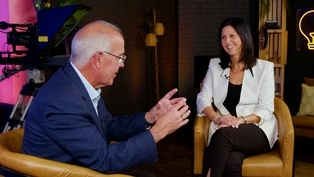
David Brooks expressing what it means to be human
Clip: S17 Ep3 | 1m 49s | Columnist, commentator and author David Brooks sees most of his work as a reflection on being human. (1m 49s)
Providing Support for PBS.org
Learn Moreabout PBS online sponsorship











Support for PBS provided by:
The A List With Alison Lebovitz is a local public television program presented by WTCI PBS