
Jericho Brown
Season 17 Episode 8 | 26m 46sVideo has Closed Captions
Jericho Brown is a Pulitzer Prize-winning poet whose work explores family and the human experience.
Jericho Brown is an acclaimed poet whose work explores history, family, and the vulnerability of the human experience. He has authored three award-winning collections of poetry, culminating in the Pulitzer Prize for his 2019 book, The Tradition. He also mentors the next generation of writers as a professor and the Director of the Creative Writing program at Emory University.
Problems playing video? | Closed Captioning Feedback
Problems playing video? | Closed Captioning Feedback
The A List With Alison Lebovitz is a local public television program presented by WTCI PBS
Jericho Brown
Season 17 Episode 8 | 26m 46sVideo has Closed Captions
Jericho Brown is an acclaimed poet whose work explores history, family, and the vulnerability of the human experience. He has authored three award-winning collections of poetry, culminating in the Pulitzer Prize for his 2019 book, The Tradition. He also mentors the next generation of writers as a professor and the Director of the Creative Writing program at Emory University.
Problems playing video? | Closed Captioning Feedback
Where to Watch The A List With Alison Lebovitz
The A List With Alison Lebovitz is available to stream on pbs.org and the PBS app.
Providing Support for PBS.org
Learn Moreabout PBS online sponsorshipThis week on The A List, I sit down with a Pulitzer Prize winner who uses poetry to examine the complex themes of everyday life.
What I love about poetr and what I'm trying to do with my poems, is always show that a poem is like a life.
And just like a life has its darkness, it is also full of joy.
You are also going to have moments of laughter and what poems allow me to d is no matter what the memory is, it allows me to survive, to conquer, to be the champion of that memory.
Because I'm the poet, I'm the person in charge, and I get to realign things a I would have them in the poems.
Join me as I sit down wit celebrated poet Jericho Brown, coming up next on The A List.
Jericho Brown is an acclaimed poet whose work explores history, family, and the vulnerability of the human experience.
He has authored three awar winning collections of poetry, culminating in the Pulitzer Prize for his 2019 book The Tradition.
He also mentor the next generation of writers as a professor and the directo of the Creative Writing Program at Emory University.
I had the chance to visit him on Emory's Atlanta campus to discuss his journey from his childhood in Shreveport, Louisiana, to the pinnacle of American poetry.
Well, Jericho, welcome to the A-list.
Hi.
Thank you for having me.
And thank you for having us at Emory.
Yeah.
This is exciting.
I'm glad you came here.
Yeah.
Yeah, I've been here 14 years.
So it's my home away from home, whether I like it or not.
You're a professor here?
Yes, I am.
How many classes do you teach?
I teach, the regular load here as a two two, teach a little less.
Because I'm the director of creative writing, a job I've had for a little bit too long, and that'll end this summer.
I think I've been doing it now maybe 11 years.
So it's something that comes in terms of three.
So I'm not sure how I managed to do it for so long, but, I am happy to let it go and to spend more tim in the classroom with students.
I love that.
Well, okay, so I don't think anything happens by accident.
I was watching a show last night.
A fiction show, a drama comedy, something.
And there was a line in there.
It takes place on the college campus.
Oh, wow.
And a professor is talking to her student and praising her for the poem that she wrote.
Oh, well, says you have to pursue this.
And the student looked at her and said, what are you talking about?
This poetry stuff is fun, but it's an oasis.
It's not going to be my real life.
Yeah.
So it made me think about you.
Yeah.
When did you decide poetry was not going to be an oasis and was going to be your real life?
You know, it is an oasis.
And it is my real life.
So I feel bad tha that character didn't understand that.
You could have both.
I just I began at some point when I was a young person, I realized I was someone who listened to what people said even though they don't mean it.
And what we say to young people, all the time is that you can do whatever you want to do.
If you work, if you work on it, if you have the discipline necessary, you can buil whatever life you want to build.
And so I just started believing that for myself, in spite of the fac that the same people who told me I could do whatever I wanted to do were also doubtful about me being a poet.
One, it didn't make sense that they wanted to tell me both.
You can't be an artist, but you can do whatever you want to do.
I think we're always given signs.
We know what our proclivities are.
We know what we love.
We know what we're passionate about.
And yet there are these voices in in the world.
And you cannot internalize those voices.
These voices in the world that try to tell us not to do the thing that we are impassioned about, because it's supposed to be hard, but why wouldn't you be doing what's hard?
What else is life for?
It's no fun to just do what's easy all the time.
How are you going to grow?
How are you going to expand if you're not actually doin something that challenges you?
So that was my goal.
That's what I wanted to do.
That's what I wanted to be because I understood I had a gift, I had a talent.
And I think it's a good idea to treat your talent like your superpower.
Nobody can write a Jericho Brown poem.
But Jericho Brown.
I'm the only one.
And that is what I contribut to contemporary American poetry and to the long, very big histori tradition of poetry in general.
And I could trust in that, that I had something to give that no one else could give.
That's what being a human being is about.
I'm just glad I figured it out when I was a younger person.
So I love that you said no one else can write a Jericho Brown poem.
Because you weren't always Jericho Brown.
Well you talk about that transition from who you were.
Yeah.
And when you decided to legally change your name, I, when I was a kid, I was some kind of odd conglomerate of shy and boisterous.
I understood as a young person that if I sat still in a corner with a book in my hand, or if I sat still in a corner writing, then adults who were around me would leave me alone.
Except for me in a corner writing adults who were around me expected me to be doing something mow the lawn, wash the dishes, vacuum the carpet.
There was always something for young people to be doing.
And I had enough about me that was interested in time that I could spend by myself, which I think, are the makings for a poet being able to be isolated for periods of time and enjoy that time.
And I think it's actually very difficult for many people to be by themselves for, for long periods of time, the time you need to read, the time you need to write, the time you need to think, which is time you have to really spend talking to yourself.
And I also grew up in a home that was very interested in education and very interested in the church.
My sister and I never wondered whether or not we were going to college.
It was made clear to us by our parents that we were going to college, and that we were going to go to black colleges.
I'm really glad that I went to Dillard University, which was an HBCU, which is an HBCU in New Orleans, Louisiana.
In my time there, was a time where I really I spent, reading and writing poetry.
I was an English major, and I was falling in love with this thing that I had some idea about.
Yeah.
I went to Dillard.
already interested in poems.
I was taking poetry workshops with a poet named Mona Lisa soloway, who I love and Revere and who literally told m when I said to her I didn't know what I was going to do with my life my junior or senior year in college.
She said, oh I know what you're going to do.
You have all this language, you're going to be a poet.
And when she said that, I thought, oh, good, somebody decided it for me.
I mean, I literally was like thank God she figured that out.
And from that point, it was as simple to me.
At least it's figuring out ho to become a poet in real life.
So that's how I became a poet.
And then when poems actually began appearing in poems, you know, and when poems actually began appearing in magazines, I got nervous because I was a third, I grew up Nelson Demery the third.
Everybody in my family calls me Trey.
You know that you've known me for a long time.
If you're calling me Trey.
So, because so many people, called me Trey, and because I had this identity as Nelson Demery the third, I felt as if I was sharin my name with two other people, my father and my grandfather.
And I wanted a name that was my own, and I wanted the freedom to write whatever it was that I had to say without being afraid of what my family would have to say about it, or without feeling like my family felt marked by something that I had done.
And honestly, I don't know that I would have felt that wa if I wasn't if I wasn't queer.
Writin love poems is going to happen.
People write them, poets write poems about love.
Historically, we expect when we read a poem that it might be about love.
What surprises us when we read a poem is when the love is homo erotic, when the love is any kind of homo erotic poem.
We wonder about the poem.
We have other questions, and I didn't want to have to deal with my family.
And so changing my name, I think, had a lot to do with seeing my seeing that name in print and wanting something that was all my ow that I could understand as mine.
And so I started writing my poems under the name Jericho Brown, and I've been doing so ever since.
And I should add, I haven't legally changed my name.
The name Jericho Brown is actually the name of my business.
Ha ha ha ha ha.
It's how I write off things for taxes.
Ha ha ha ha ha hahaha.
So the name everyone calls me, Jericho Brown is actually the name of a business that is a small business registered in Georgia.
By choosing to define his own identity, Jericho embraces the freedom of expression that poetry represents.
It's a freedom that leads to sincerity and an openness to inspiration whenever it comes.
Even when it's inconvenient.
When you have those inspirations or you think about words or sentences or ideas or do you stop in your tracks, are you do you have to write it down immediately?
Is that how poetry comes to you, or is it a both and is sometimes you sit dow and really think, I'm going to write today when I am my best, I am writing on the elevator.
I'm pulling my car over in Atlanta.
Traffic to write down a line when I'm doing what I really should be doing.
I feel like I'm doing i all the time and I have to stop whatever I'm doing.
Sometimes I'm teaching a class and I'll say to my students, y'all just give me one second, I gotta get this down.
That was too good.
When I do that, when I'm teaching a class, I'm always happy to do it because I'm giving them a example of what my life is like and what their lives can be like as a writer.
And people don't necessarily understand that.
When you are a writer, as is the case with you, when you do the kind of work you do, you make your lif such that it can fit your work.
I build my life around my poems.
So, yes, when I get a line, i doesn't matter what I'm doing.
I stop what I'm doing unless I'm cuddling.
If I'm cuddling, there goes the Nobel.
That's it.
What That's it.
Love, love.
Yes.
It supersedes everything.
So some things you can't let go you shouldnt.
Well, not the Nobel yet.
But you do have the Pulitzer.
I do have the Pulitzer.
Hallelujah.
You know, and it's so funny.
I wanted it since I was ten, so I'm very happy.
Yes.
Rita Dove Yes.
Rita Dove.
I was either 9 or 10 years old when Rita Dove won the Pulitzer Prize.
She obviously won the Pulitzer Prize at a time when the teachers in the Caddo Parish public schools were very awar of who won the Pulitzer Prize.
I don't know if teachers in the public schools are aware of this right now, bu the next day I went to school, people kept telling me the teachers at my elementary school, teachers who just saw me in lines in the hallway, you know, you stand in line when you're elementary school to go to lunch or to go to the bathroom would stop me to say, Rita Dove won the Pulitzer Prize.
Did you know that?
It was very strang because of course I didn't know.
I had no idea who Rita Dove was.
A few weeks later, an definitely by the fall semester, when I came back to to elementary school, there were life posters of Rita Dove in the school.
She was black.
And I realized oh, y'all were telling me that because this black woman won the Pulitzer Prize and you, as teachers, wante this young person who you knows.
You know, I'm writing poetry all the time.
Even then, I was writing poetry all the time, insisting with my teachers that I read a poem at the end of class.
I would tell Miss Adkins who was my fifth grade teacher, can I read this poem t the class at the end of class?
She would say, sure.
So these are the kind of people who knew they knew what I was doing.
They knew what I loved, an they told me that I could do it.
Although years later those same teachers were like, well, you want to be careful with that.
You want to think about that.
So this is an example of what I'm talking about.
But when Rita Dove won the Pulitzer Prize, I didn't really know what a Pulitzer Prize was.
I just knew she had won it and therefore knew that I should, too, that I should be trying to do whatever made teachers stop me in the hallway to tell me that had happened.
And now people are stopping out there.
Little kids, I hope so, that's beautiful.
You want to make me cry?
I would love that.
I love thinking about that.
I love being there for people in that way.
If I can be some kind of example to people that they that they can follow their own dreams.
I am happy to have that.
That makes me very emotional.
Thank you for saying that.
I appreciate that.
Thank you thank you, I hope so, I hope so.
So you've been a published poet.
You've written three books.
I want to talk about the poetry and as a gift to others.
Yeah I don't know how to frame this.
That I'm really explaining myself, but I'll say that when I hear yo recite your poetry and explain context, it adds another layer of it.
When I read it in the book it feels like a gift to me that I ca then interpret however I want.
And I sort of read into the narrative.
And that feels almost more vulnerable than even the writing of it that you're gifting me, or gifting the reader this nuanced approach to your life without the context.
Yeah.
Is that scary?
I think in general, poets are people who have a hard time communicating otherwise.
Yeah.
I feel things deeply and I want to make them known.
I see things in ways that I know only I can see them.
And it's hard to explain them in poems.
Give me the opportunity to explain them, but they also give me the opportunity to take, language that appears around memories that are not so hot.
You know, you have these memories you don't like, you have traumatic moments in your life.
And poems create this world where you can quite literally take that out of your body.
You can take that memory out of yourself and put it somewhere and organize it.
What I love about poetr and what I'm trying to do with my poems, is always show that a poem is like a life.
And just like a life has its darkness, it is also full of joy.
You are also going to have moments of laughter.
And what poems allow me to d is no matter what the memory is, it allows me to survive, to conquer, to be the champion of that memory.
Because I'm the poet, I'm the person in charge, and I get to realign things a I would have them in the poem.
And what I do as a poet for other people is the same thing I do for myself.
When I am writing the poem, I am affirming the fact that I survived.
I am affirming the fact that I'm the champion.
Isn't that something?
Yeah.
And you get to do that when you read a poem.
That's why people are a little bit afraid of poems, too, you know because they ask us to be real.
They ask us to move toward complexity.
Everything about our culture tells us not to be complex.
But poems, poems don't allow us to do anything other than let go of this idea that things are simple because they're complex, and they let us look at our lives and love ourselves.
There's a lot in this world that we would like to eschew, we would like to get rid of.
But if you read poems enough, then you understand.
You don't have to ge rid of that.
You can embrace it.
You can embrace that part of your identity that you've been told is bad or evil or that is not good.
You can understand that.
It is a part of you and it makes you a whole human being of complexity and depth.
This is a poem called Crossing.
Crossing the water is one thing and one thing for miles.
The water is one thing.
Making this bridge built over the water.
Another.
Walk it early, walk it back when the day goes dim.
Everyone rising just to find a way toward rest again.
We work.
Start on one side of the day like a planet's only sun.
Our eyes straight until the flame sinks.
The flame sinks.
Thank God I'm different, I figured and counted.
I'm not crossing to cross back.
I'm set on something vast.
It reaches long as the sea.
I'm more than a conqueror.
Bigger than bravery I don't march, I'm the one who leaps.
Hearing Jericho read from his Pulitzer Prize winning book is a reminder of the power of his work.
And thoug awards like the Pulitzer bring a broader audience.
Jericho never forgets the intimacy of connecting with a single reader who might be changed by his words.
if poetry, as you've sai before, is a prophecy of sorts.
Yeah.
What do you hope future generations take from what you've written?
That is a scary question.
I have to say.
I can't think in term of generations, because if I do, I will get pessimistic and I want to stay optimistic.
So in order for me to stay optimistic, I don't think about crowds or wide swaths of people.
I am not Beyonce.
I do not need to feel a stadium.
I only need to touch one person.
There's a way when you're listening to a pop song, that even as you'r listening to it, you understand.
This was made for us for a minute.
People to share in.
When I write a poe and when you're reading a poem, you feel as if someone is talking to you.
It's a conversation between two people.
So many people can buy my book.
Everyone is welcome to buy my book at the same time.
When they read the book, they will feel as is my plan, as is what I learned to do in school as is what I love about poetry.
They will feel tha they are having a conversation between 1 and 1.
And if you have a conversation between 1 and 1, my the caretaking I'm doing isn't necessarily about future generations as it is about intimacy.
When I make a poem, I am tryin to create a space of intimacy.
And so if you get something from it, what you get, one of the things you get is the understanding that you can be alone in a room and be changed by a book.
And so what I would like to d is leave something for a mind, a single mind any one will do.
I don't get to know who it is.
I don't think about future generations as much as I think about changing a single mind.
Well, you got me good.
I'm glad.
Congratulations.
Good job good job.
You're a good reader.
As Jericho continues to seek new ways to express the nuances of life and love, his work remains a testament to the enduring power of asking questions.
Is there anything in your life that you've not been able to put words to?
Yes, I hope so.
I hope there's plenty I haven't been able to put words to because that means I have more to write.
I don't want to stop.
What I love about being a poet is I feel that as long as I have fingers to type wit an eyes to see what I'm writing, and I guess if my eyes if I lose my eyes, hopefully I can learn Braille.
Do you understand what I'm saying?
Like what's important to me is that I don't.
I mean, you're asking me this question, and it's what I think about all the time.
Do I still have material?
Are there still things that bother me enough or that I love enough?
Or that I get excited about enough?
That I want to find language for them in my subconscious mind, not in my conscious mind?
Allison.
Now I want to find language for them because I have a story to tell that I'm aware of, but that my mind is already looking for language that I don't even know it's looking for.
My mind is already making languag out of experiences that I've had that I don't even understand were as important to me as they were.
Does that make sense?
Last night I was working on this poem at 3:00 in the morning until about it must have been five something for something in the morning.
I was working on this poem, and I was so angry about it because I knew I had to be here, and I knew that meant I wouldn't be here with as much sleep as I would like.
Which is why you caught me in the restroom, putting makeup on my face so that there wouldn't be bag under my eyes that I gained from writing a poem.
But I would rather write the poem than have the sleep.
One of the things that appeared in that poe is a little piece of knowledge I had that I did not know was important to me.
I did not know until I was writing this poem that it was important to me that CeCe Penniston wrote, finally, her hit record, her first song, which was a big worldwide hit while she was in a college chemistry class.
Finally, is a song about falling in love.
She wrote this song about finally meeting the man of her dreams while she was sitting around beakers and test tubes and Bunsen burners.
So I have this poem with beakers and test tubes and Bunsen burners in it, because CeCe Penniston wrote that song about something that has no science.
Love is not a science.
Do you see what I mean?
So I've got this little love poem I'm working on now, and it feels good to have a thing that I'm working on, in spite of the fact that I had no idea that I was going to be working on it, that it is a surprise to me that I'm up late at night in spite of all of those facts.
That's exactly what I want.
I want to be surprised by what I say.
I want language I do not expect.
I want to be saying that which I must say, as opposed to saying that which which I think I have to say, if I write that which I think I have to say, then I'm going to end up writing a speech.
I'm not here to write a speech.
I wrote speeches speeche for years.
I'm not interested.
I'm here to write that which calls my entire self into question.
That's what I'm doing when I'm making a poem.
The reality tha you're constantly calling things into question, but providing us with so many answers.
Oh, wow.
Thanks is a beautiful thing.
Thank you Jericho, thank you so much.
Thank you.
Watch even more of the shows you love any time with TCI passport on the free PBS app.
Download it today.
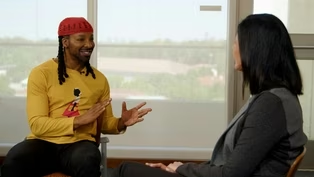
Jericho Brown talks about his inspiration for winning the Pulitzer Prize
Clip: S17 Ep8 | 2m 20s | Since he was a child, Jericho Brown was inspired by fellow poet Rita Dove. (2m 20s)
Providing Support for PBS.org
Learn Moreabout PBS online sponsorship New Episode
 New Episode
- Drama

Lesley Manville and Tim McMullan return in the final installment of the Susan Ryeland mysteries.
 From My Station
 New Episode
 New Episode

 New Episode


 New Season

Support for PBS provided by:
The A List With Alison Lebovitz is a local public television program presented by WTCI PBS