
July 31, 2026
7/31/2026 | 55m 43sVideo has Closed Captions
Amy Goodman; Tia Lessin; Sarah Elizabeth Lewis; Rev. Wheeler Parker, Jr.; Paulina Borsook
A new doc about Amy Goodman's work on "Democracy Now!" highlighting the importance of good journalism. She and director Tia Lessin discuss. Professor Sarah Elizabeth Lewis and Rev. Wheeler Parker, Jr., cousin of Emmett Till on the new photo exhibition about Till's life and tragic death. Paulina Borsook's 25-year-old critique of tech culture, "Cyberselfish," is trending again. She discusses why.
Problems playing video? | Closed Captioning Feedback
Problems playing video? | Closed Captioning Feedback
July 31, 2026
7/31/2026 | 55m 43sVideo has Closed Captions
A new doc about Amy Goodman's work on "Democracy Now!" highlighting the importance of good journalism. She and director Tia Lessin discuss. Professor Sarah Elizabeth Lewis and Rev. Wheeler Parker, Jr., cousin of Emmett Till on the new photo exhibition about Till's life and tragic death. Paulina Borsook's 25-year-old critique of tech culture, "Cyberselfish," is trending again. She discusses why.
Problems playing video? | Closed Captioning Feedback
Where to Watch Amanpour and Company
Amanpour and Company is available to stream on pbs.org and the PBS app.
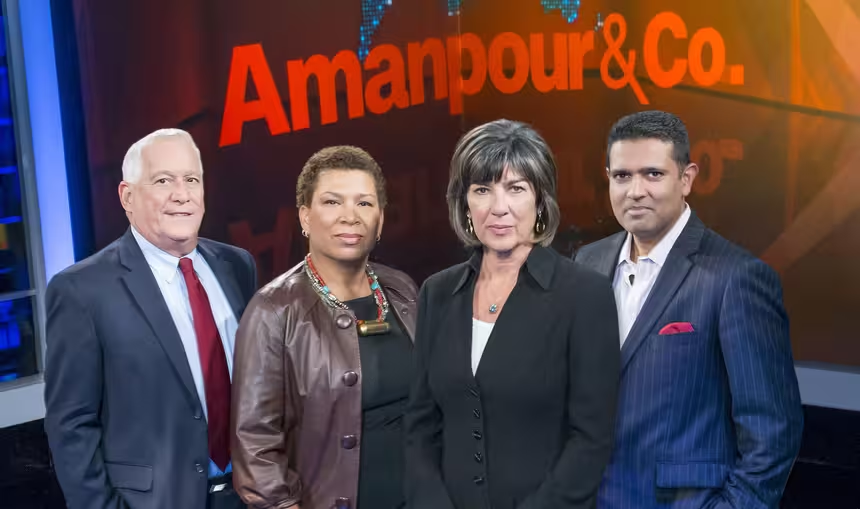
Watch Amanpour and Company on PBS
PBS and WNET, in collaboration with CNN, launched Amanpour and Company in September 2018. The series features wide-ranging, in-depth conversations with global thought leaders and cultural influencers on issues impacting the world each day, from politics, business, technology and arts, to science and sports.Providing Support for PBS.org
Learn Moreabout PBS online sponsorship[MUSIC] Hello everyone and welcome to Amanpour & Company.
Here's what's coming up.
He accused me of harassing him and I said, "Sir, a reporter asking you a question is not harassment.
It's our job."
Does journalism face its gravest danger yet?
I speak to reporter Amy Goodman and filmmaker Tia Lessin about their new documentary exploring the fight for an independent press.
Then... When you ask the question, "What if Emmett Till lived?"
What you're really asking is, what would have been required in American society for him to have lived?
A powerful new exhibition imagines the life Emmett Till was denied.
I speak to historian Sarah Lewis and the Reverend Wheeler Parker Jr.
also ahead.
So you had Silicon Valley invaded by toxic Wall Street bro, finance bro culture.
And that to me was the beginning of when things really began to change.
And that is a very woman hospital world.
Long before Silicon Valley dominated our lives, Paulina Borsook warned of its growing power.
Michelle Martin speaks to the journalist who saw today's tech titans coming.
Amanpour & Company is made possible by The Anderson Family Endowment Jim Attwood and Leslie Williams Candace King Weir The Sylvia A. and Simon B. Poyta Programming Endowment to Fight Antisemitism The Strauss Family Foundation The Peter G. Peterson and Joan Gantz Cooney Fund Charles Rosenblum Monique Schoen-Warsaw Kou and Patricia Yuen Committed to bridging cultural differences in our communities Barbara Hope Zuckerberg And by contributions to your PBS station from viewers like you.
Thank you.
- Welcome to the program, everyone.
I'm Christiane Amanpour in London.
The media industry today is facing more danger and disruption than ever, as it confronts the twin pressures of corporate consolidation and a president's attacks.
And now the future of one of the biggest proposed media mergers has been thrown into doubt, after Paramount agreed to delay its takeover of Warner Bros.
Discovery, which is the parent company of CNN, until next summer amid a court challenge from states across America.
And after last weekend's ill-tempered do-over of the White House Correspondents' Dinner, there is renewed debate about the relationship between the press and political power.
Questions about who owns the news, who holds power to account, and what independent journalism looks like feel more urgent than ever.
For more than three decades, Amy Goodman has built her career asking questions that many others wouldn't, reporting from danger zones inside and outside America, challenging presidents and giving a voice to those often left out of the mainstream conversation.
That's all on her show, Democracy Now.
A new documentary called Steal This Story, Please, examines her life, her work and the growing struggle for independent journalism.
My first impressions of Amy.
What did you say to those who say that you're a war criminal?
Man, she doesn't care what anybody thinks.
Don't push me.
I'm a journalist here.
Independent media is the oxygen of a democracy.
What do you mean by independent?
Not being sponsored by corporations.
Amy's chaotically brilliant at the spy game.
We began on nine radio stations.
If she believes something, she's going to fight for it and get it out to the world.
Straight up journalism.
It came from my Jewish education that you ask questions.
Sharif, can you talk about what's happened on the Gaza Strip?
From ground zero from East Timor.
This we deplane in Haiti.
Georgia's death row prison.
Amy and one of the film's co-directors joined me from New York to discuss this struggle.
Amy Goodman, Tia Lessin, welcome to the program.
It is an amazing film.
It took me all the way back to what I call, you know, really traditional journalism, and it's great to be reminded of what can be done by you fearless person, Amy Goodman.
Let me just first ask Tia, what is it about the concept of Democracy Now that you decided would make a good film?
Yes, well, thank you so much for having us on, Christian.
Amy created this incredible model of independent journalism.
It does not take corporate money, no underwriting, no advertising.
It doesn't take government funding.
It is entirely financed by audience, its listeners and its viewers, and, you know, nonprofit institutional givers.
So what that means is that it is not controlled in any way, shape or form by the powers that be.
And we see right now how important that is as the Trump administration uses so much political pressure to lay siege to news organizations and to journalists themselves.
So it seemed to be the right time to tell this story about independent journalism, Amy Goodman style.
And of course, we're all very aware of this pressure coming from the government and from corporates who bend the knee, so to speak.
So it's really refreshing to see this documentary and to talk to you, Amy, as well.
So how does it feel to be on the other side of the camera, sort of the subject of this kind of film?
And please tell me, what is the title?
Steal this story, please.
Well, you know, we've always said that, I say, to have an exclusive is a failure.
We want it to be stolen by everyone.
When we cover the standoff at Standing Rock, that's the Standing Rock Sioux taking on the Dakota Access Pipeline, this epic struggle back in 2016 at the time of the presidential race between Donald Trump and Hillary Clinton at the time, when rarely in the media were they even talking about the climate change.
But thousands of indigenous people went to North Dakota here in the United States supporting the Standing Rock Sioux, and they stood off against this large energy corporation.
We were among the only media there, and we captured on film the dogs that were being held by the security guards, biting the protesters, their mouth and nose, dripping with blood.
And we just posted online within 24 hours there were 14 million views.
President Obama was in Laos at the time and one of the people who participated in the democracy forum he held said, "What about this?
What's happening there?"
And he came back to the White House, saw the footage.
It wasn't lost on the first African-American president what it meant to unleash dogs on protesters.
And to capture the image is so important.
And to share that and to hear the voices.
You know, our motto is to go to where the silence is.
And it's often not silent.
It is raucous.
It's rowdy.
People are organizing, as you see, all over the United States now when it comes to the immigrant crackdown.
It just doesn't hit the corporate media radar screen.
That's where democracy now lives.
It is extraordinary.
And of course, when you talk about the dogs, and of course, I saw the images, and then I was shocked that it hadn't been a subject of mass media attention.
And the way you say now that, of course, it wasn't lost, that imagery, that fact, on the first African-American president.
Also, and, Tia, I am sure that this grabs you as well, we are right in the middle of literally one of the worst tipping points here in Europe anyway of drought and fire and climate change.
And I just wonder whether when you were starting to make this film, you sort of realized how existential some of this lack of reporting by the mass media has been.
Absolutely.
I mean, we start the film with this chase scene, Amy Goodman in hot pursuit of President Trump's climate adviser at the climate conference in Poland.
And this is a man who's sent there to represent the U.S.
government's position at the U.N.
climate conference, and he couldn't run fast enough from Amy Goodman.
And she's really just asking, you know, the basic questions that any good journalist will ask of a government entity.
You know, why have you pulled out of the Paris climate accords?
Why are you promoting coal and fossil fuels at this climate accord?
And he wouldn't answer a single question.
He wouldn't even give her his business card.
That is how, you know, threatened this administration is by these hard questions and really how they can, you know, not face any accountability from the journalists.
You know, he accused me of harassing him.
And I said, sir, a reporter asking you a question is not harassment.
It's our job.
I'm going to play exactly the video that you're talking about.
Hi, I'm Amy Goodman from Democracy Now!
Can you tell us what you think about President Trump saying climate change is a hoax?
You can answer the question.
You're not speaking to the press here?
I'm sorry, I'm running late for a meeting.
Right, but you weren't running late when you were just standing there.
Can you talk about President Trump's saying that climate change is a Chinese hoax?
So here we are, that was the first Trump administration, here we are when they're doing a huge amount more to roll back and actively pay billions of dollars to roll back all sorts of climate mitigation efforts and climate constraints and controls, and we're in a really bad situation.
Do you think -- and, Amy, I was struck by one of your producers, one of your colleagues, who talked about how you all went to cover the lead-up and the Iraq War of 2003, and he said, "We were devastated" -- maybe I'm paraphrasing -- "that we couldn't stop the Iraq War."
And I'm sitting there thinking to myself, "Really?
You really think you could stop this stuff?"
So this is my way of asking you, do you think your job is to try to stop this, whether it's climate, whether it's war?
And what about people who say that you're more activist than journalist?
- Our job is to show the images, to interview the people who are so often not heard.
And I'm not talking about a fringe minority, not even a silent majority.
I mean, when we're talking about people who care about war and peace, who care about the climate catastrophe, the wildfires around the planet, who care about LGBTQ issues, racial justice, and the immigrant crackdown, are not a fringe minority, not even a silent majority, but the silenced majority, silenced by the corporate media, which is why we have to build a network of independent media all over not only the United States, reporters know no borders, but around the world.
There's a reason why our profession, journalism, is explicitly protected by the U.S.
Constitution.
It's freedom of speech and freedom of the press.
The flip side of freedom of the press is the public's right to know.
It's the only way you can have a meaningful democracy.
If people have information they can trust, then they can make up their own minds across the political spectrum.
And you know, Tia, I mean, look, our great founder, Ted Turner, created this network to do exactly that, to be reporting the truth, the facts, without fear nor favor, to not be in hock to corporates.
And why do you think that the actual corporate media has got to this stage?
What are the pressures that you can see that have happened over the last 20, 25, even maybe longer years?
Well, as we show in the film, you know, Amy Goodman has been sounding the alarm about the dangers of media consolidation.
Ever since the 1996 Telecommunications Act, we've seen larger and larger corporations take on more and more news organizations, broadcast radio, television, print publications.
And that's just way too much power in too few hands.
It is now to the point, you know, we've got this media consolidation on steroids under this administration.
And, you know, your own network, which has been in the crosshairs of the Trump administration, of Donald Trump, for so many years, may be victim to this.
The merger between Paramount and Warner Bros.
Discovery may put CNN under the Ellison family and join it with CBS, which means that two major broadcast networks are under the same roof.
You know, Donald Trump has accused CNN and The New York Times of treason for its coverage of the war in Iran, you know, which is just outrageous and incredibly chilling.
He's also attempting to use his regulatory authority, threatening to pull licenses from networks.
He's also eliminated all the funding for public media stations.
So, you know, what Amy Goodman and Democracy Now!
has done is create this model which is sort of free from that kind of pressure and that kind of corporate influence.
And, you know, she doesn't need to curry favor with an administration for fear of her license being pulled or for fear of a merger not going through.
You know, she is able to report on the ground, you know, the most important, most consequential stories of our day.
I'd like to ask you, Amy, about one of the very, I thought amusing, but really interesting interactions you had with a president that's shown up in the documentary.
So that's President Clinton on the day of the 2000 election between Al Gore, his vice president, and George W. Bush, and he calls a bunch of media, I guess, to try to get out the vote, and he calls you.
And we're going to play a little part of it, because it's in the middle of a salsa program on your station.
I think you had to bust into this live program and take this call from the President of the United States.
But you did not only stick to what the White House wanted to be their talking point.
Here we go.
>> You hear salsa music loud, and underneath it all, President Clinton is saying, "Hello, hello.
Is anyone there?"
>> Mr.
President, are you there?
>> I am.
Can you hear me?
>> Yes, we can.
You're calling radio stations to tell people to get out and vote.
What do you say to people who feel that the two parties are bought by corporations and that their vote doesn't make a difference?
>> That there's not a shred of evidence to support that.
That's what I would say.
It's true that both parties have wealthy supporters, but -- >> It was very interesting, talking to the leader of the free world.
>> What did you make of that?
Because, yes, he got all slightly bent out of shape, that you were taking the conversation into journalistic territory and not just a PR agent for Get Out the Vote, but he also stayed and engaged with you for about 30 minutes.
That's right.
I mean, this was an astounding moment.
A lot of the media covered this interview.
He was supposed to call in during Democracy Now!, which was the hour before.
He didn't call, so I thought it was a prank call when they said the White House is calling.
I actually thought they said the White Horse was calling, which is a historic bar in Greenwich Village here in New York.
But then when he did call into the music show, I ran in, and we started the interview.
And yes, I understood he wanted to get out the vote, but there were so many issues that we had to engage in, from Iraq to the bombing of Vieques in Puerto Rico, to whether he would be granting clemency to Leonard Peltier.
That would happen about a quarter of a century later.
But most importantly, yes, he stayed on, and then he said he had to get off.
And then I got a call from the White House, and they said they were going to ban me.
And I said, "What are you talking about?
He called me.
I didn't call him."
And they said, "You kept him on the phone for half an hour."
I said, "He's a leader of the free world.
He can hang up if he wants to."
But that's our job, not to be unbended knee to those in power, but ask the questions that so many people have.
>> Exactly, and I was actually -- I laughed when you said he could hang up whenever he wants, because, of course, Donald Trump likely would have hung up whenever he gets a question that he doesn't like or he's taken off on areas that journalists want to ask.
He calls them "fake news" or whatever it is.
So, I do think that was really interesting.
But, Amy, I want to end by asking you, because the film, "Tia" does a really good job of going into your family history, your brother starting his own newsletter when he was a tiny young boy, the fact that he wouldn't take even, you know, censorship from your family.
And you describe this as your commitment to this free and independent press is rooted in your Jewish tradition of asking questions and thought and knowledge and all of that.
Tell me a little bit about that.
I mean my grandfather was an Orthodox rabbi and we debated all issues.
That was on my mother's side, on my father's side, my great-grandfather, a Hasidic rabbi, the Henry Street rabbi, going back to the founder of Hasidism.
And everywhere in our family, we were asking questions.
And, you know, we cover extensively the Middle East, we cover what's happening in Gaza and Lebanon.
And that is not in spite of my Jewish education.
That is because of it.
I mean, I was steeped in the Holocaust, lost family members, family members that fled, family members that couldn't.
And always as we grew up, I mean, the message was never again for anyone, anywhere.
It's a really powerful story that you tell.
Your story is powerful.
I really admire you fighting this great fight.
Well done, Tia, for making this film.
And I think a lot of people will get a lot of energy out of watching how positive independent media can be.
And you've done a great job.
So congratulations to both of you.
I'm obviously, you know, an interested party.
I make no apologies for it.
It's great to see it and thanks.
And well done, Amy Goodman, journalist, Tia Lessin, co-director.
>> Thank you so much, Christiane, and thank you for all your work.
>> Thank you, Christiane.
>> 85 years ago this week, Emmett Till was born in Chicago.
The boy was just 14 years old when he was abducted and lynched in Mississippi 71 years ago.
It's a murder that ignited the civil rights movement after his mother demanded an open coffin, insisting that America see the brutality of its racial violence, a brutal image that is still so hard to look at.
Now, a new exhibition at the Museum of Contemporary Photography at Columbia College in Chicago asks a profound question.
What if Emmett Till had lived?
Through photographs spanning decades of American life, it imagines the future that he was denied.
I spoke with historian and curator Sarah Lewis and with Reverend Wheeler Parker Jr., Emmett Till's cousin and the last living person to have seen him before his abduction and murder.
Reverend Parker and Sarah Lewis, welcome to the program.
Can I ask you, Reverend, it would be Emmett Till's 85th birthday this week.
As you know, the governor of Illinois has declared his birthday July 25th as Emmett Till Day.
And many say that his killing was the catalyst for the civil rights movement.
I want to ask you a personal question, obviously.
What do you personally remember about your cousin, and particularly that very last day when you saw him being dragged from your house?
Hmm.
Wow, that's a powerful question.
It's loaded.
I remember very well and the atmosphere in the house, 2.30 in the morning, dark of the thousand midnights, and thinking and wondering what's going to happen.
He had no idea what was becoming of him or where he was going or what they were going to do to him.
He had no way of knowing.
They tried to prepare him, but he had nothing to let him know exactly what he was facing.
It's a very helpless, helpless, helpless feeling.
I can't find the words to describe the feeling.
Knowing where I was, knowing the kind of people we're facing and something that we knew happened, and we knew it could happen to him, but we avoided it because we practiced and followed the Southern mores.
He didn't know it.
- Oh, that is so hard to hear.
And I really feel for you.
I want to ask you, Sarah, because Rosa Parks had said that she thought of Emmett Till when she refused to get up and vacate her seat under orders on that famous bus.
What was it about this story and this person, Emmett Till, that made you want to do this exhibit now?
It's impossible to understand American history and the catalyst for the civil rights movement without engaging with the history and life of Emmett Till.
I decided to create an exhibition, a creative monument, and a book to celebrate his unlived life when I began to see for myself the decades of resistance that have taken place in defiance of the attempts to memorialize and to honor Till.
And those acts of resistance, which include the bullet shot marker that's meant to honor the site where Emmett Till's body was bought at the Tallahatchie River in Grey Bull Landing in Mississippi, to many others, really represent why bravery is required to confront American history.
When you come to see the consistent efforts of resistance to honoring even 70 years later Emmett Till's life, it forces a level of urgency in you, and as it did in me, to contribute and to do what's required to engage with this legacy.
I had my life transformed by meeting Mamie Till Mobley when I was just 14 as well, and in that, years later, began to see that she set forth a motto that we're still engaging with today, "Let the world see," she said, "what they did to my son."
But today the question is, what will let people see the reality of American history?
Is it enough to just let people see?
I think today we have to, at times, make people see, entice them to see.
And this exhibition, with over 180 photographs that unfurl his unlived life, offers a new arena to engage with it.
And it's a show that's done alongside other initiatives, from Robert's Temple to work in Greybull Landing today.
You've just laid that out beautifully, and we of course had that image of that destroyed and defaced memorial.
But I want to ask you, because you raise the issue of Emmett Till's mother, who was probably one of the bravest and one of the most defiant people, not just women, but people who we can imagine right now.
Because in the face of her mourning, in the face of being at the funeral, she told the pastor that she absolutely needed this coffin to be open.
And decades later, she talked about it.
And I'm just going to play this so that you, Reverend, and you, Sarah, can just listen to it, and we'll talk about her reflections.
Mr.
Rayner asked me, he said, "Do you want me to touch the body up?"
I said, "No, Mr.
Rayner.
Let the people see what I've seen."
I was just willing to bear it all.
I think everybody needed to know what had happened to Emmett Till.
Reverend Parker, you were just a couple of years older than your cousin Emmett.
And I know you called him Bobo, but I want to know what comes back to you as you hear his mother make that very brave declaration.
And I don't know whether you were at the funeral and you saw the open casket.
I attended the funeral.
I was there.
And we have a teaching that we can see each other again.
So in my mind, I had no sorrow, no hate, no real feelings.
I said, "That's not him."
At the same time, I knew it was him, but I believed that I would see him again.
And I remember Amy as an extraordinary person because her mother not only controlled, for the lack of another word, her life, but she prepared all of us how to face the future.
What I mean by that is the church I now pastor, which is celebrating 100 years in September, started in her house.
So we were very well entrenched in how to handle the situations, how to deal with life, how to deal with the bumps in the road.
And this was a bump in the road.
And Amy was prepared, not knowing what she was going to face.
Same thing with all of us that come up around my Aunt Alma, which was, she was, we said she was the Fonz.
When she spoke, everybody listened.
Had a very soft voice, but it was a commanding voice, a demanding voice, and very drawing and touching and sweet kind person.
Emmett Till, Bobo, and his mother were like sisters and brothers as far as I was concerned, because everybody had to cater to Aunt Alma.
But she could come in the room so softly and say, "Sweetheart, you do this, and Willie, you do this here," and everybody would get busy, and she'd go sit down.
That's the kind of person she was.
Well, on that sweet note, let me ask you, Sarah, we've asked you both to choose a couple of images that you want to talk about in this exhibit.
So tell me about one of the ones that you've selected and what it means to you, Sarah.
You know, had he lived, what would his life have been like?
Yes, yes.
A photograph by Stephen Mark, 1988, young boy suspended in the air, thrown up by his father, for me is an emblem of this question.
What if Emmett Till lived?
This photograph is one that jolted me when I looked through 18,000 images in this collection at this Museum of Contemporary Photography in Chicago where the exhibition is held.
I asked myself who could Till have been as I looked at this young boy confidently suspended in midair, thought of all I had learned about Emmett, who Reverend Parker knows as Bobo, that he loved jokes, he was constantly helping others, that he loved to fish, go to the beach, he could have been a minister, he could have been a leader.
And then caught myself in that act of imagination thinking of Till as that father and had to catch myself as I realized that he couldn't have been.
And so in this photograph we have suspended possibility, we have suspended dreams, and we have an emblem of what's really forced on us for the reckoning of this country.
What cut short Emmett Till's life?
When you ask the question, what if Emmett Till lived?
What you're really asking is what would have been required in American society for him to have lived?
What would have had to have changed?
And this is the work of the moral imagination that's required for creating a new chapter.
I think of Mamie Till Mobley in this photograph as well.
When she was determined to let the world see what was done to her son, she was prophetic in getting us to engage with the power of the imagination for the work of justice in society.
She understood and wasn't alone in this understanding.
She understood what Frederick Douglass did about the power of the critical imagination for justice.
She understood what W.E.B.
Du Bois did, what photographers like Gordon Parks did, and contemporary photographers like Carrie Mae Weems and Hank Wills Thomas and Deborah Willis did.
She really pointed us forward to what's going to be necessary today, which is the work of culture for justice.
Let me ask you, Reverend, about, tell me a particular image that you've chosen for us and why you chose it.
The particular image I chose reflects the time, during that time, for that time.
And it shows that we had to be creative.
If you notice my image, it had no tricycles or bicycles or bought things from the store.
We had to create games, hopscotch and things that cost no money and we got good at it.
So it takes me back there right away.
And that's where we lived and we had more fun than the law allowed doing those things.
And we appreciated it.
And it was all inclusive.
You could include everybody.
You didn't have to have a baseball glove or you didn't have to have a baseball bat or a pair of gym shoes.
Just show up with your body and have a lot of fun.
And what clearly was not a lot of fun for you all those years later is visiting the barn and we have that image where your cousin was tortured and lynched.
He was killed, he was murdered, he was assassinated.
What do you think when you go to that place, which must be just so utterly painful, and you're 87 years old?
I learned from this story, it's not a pretty story, it's an ugly story, but it's American history.
And it's so much to learn and so much good came out of it.
But at the same time I'd rather have him not have had the story.
But the life, he gave his life so to speak, that others may live or that others may have a better life.
Not intentionally.
So I have mixed emotions, you know.
We'd rather for it not to have happened.
But he speaks louder in death.
And he accomplished more in death than he would if he had lived.
Yes, we said it sparked the major, you know, chapter of the civil rights movement in the United States.
But here we are in the year 2026, and there is an actual attempt by the current government to deny that history.
I mean, I spoke to Lonnie Bunch, the Secretary of the Smithsonian, around the 250th anniversary of the United States, and he was telling me about how American history had to be marked, celebrated, understood in all its dimensions and diversity.
But just now, President Trump has ordered the National Park Service to install temporary signage near the Smithsonian, warning of what the administration views as "inaccurate information" presented in the exhibits.
You know, we've just been speaking about what Emmett Till means to history, and yet here is history being attempted to roll back, to be rolled back.
How do you combat that?
What do you think about that?
It really hurts.
I've never known the American history for black men as I should.
We knew that there was racism and all those.
But we don't tell our stories and they don't want because it paints America in a way that we don't want America to be seen.
But you should know the truth and the truth will make you free.
Some of the things that we don't tell, we should tell.
I was listening to a talk showing, they're trying to get the Jews to stop showing the stories of Holocaust.
No, you need to know this.
So we're going to tell it as long as we can.
You need to know the history.
People need to know the history without having any ill will and a marcel hate.
I noticed when I learned this story and a lot of blacks don't like to talk about it because they get angry, they get mad.
No, we know it because we don't want to repeat it again.
Don't let it control you.
Don't let it make you hate.
Don't let it make you have the wrong feelings.
But take that lemon and do like Amy Till's mother did.
In her last reconciliation speech, she said, "It's like those people who killed my son don't have... It's a powerful speech.
It's like they don't exist.
I have no hate.
God's revenge is mine.
And I found out we both were telling the same stories, going for positive, because we were taught by her mother and others of the faith that hate destroys the hater.
We can't afford to lecture hate.
And she took that negative and turned it into a positive.
It's an amazing story.
"If Emmett Till Lived" is an amazing idea for an exhibit.
Sarah Elizabeth Lewis and Reverend Wheeler Parker Jr., thank you both so much, indeed, for joining us.
>> Thank you.
Thank you so much for having us.
>> Thank you very much.
Appreciate you.
Keep doing a good job.
>> 30 years ago, Silicon Valley promised to change the world.
It did, just not in the way many imagined.
Today, a handful of tech billionaires wield extraordinary power over our politics, our economy, our public discourse, and even our thoughts.
But one journalist saw the danger long before big tech became big power.
Paulina Borsook warned that Silicon Valley's libertarian ideology, disdain for government and worship of wealth, would reach far beyond California.
Her once overlooked book is now being republished for a new generation.
And Michelle Martin speaks with Borsook about why her critique, which was published in the year 2000, is resonating now.
Paulina, Borsook, thank you so much for talking with us.
Well, thank you for having me.
Your book, Cyber Selfish, first came out more than 25 years ago.
It was out of print.
And through a sort of a magical process, which we don't have time to go into here, it has been rediscovered by a whole new generation of fanatical readers.
And I just wonder why you think it is resonating so deeply today.
I think there's two things.
I think all the issues that I describe in the book, everyone is now seeing around them all the time.
Like, oh, this is a book that can articulate and frame what I'm seeing.
The second thing is, and I'm just giving you feedback from what I've been told, is that particularly people younger than me are really happy to be reading a book that is kind of in the tradition of the new journalism.
It's funny, it's playful, it's not didactic, it doesn't read like a TED talk.
They like the style, they like the fact that it's really kind of like an irreverent travelogue through subcultures of Silicon Valley and I think readers find that really enjoyable.
I'm not having one point I'm trying to beat to death in it.
It's sort of like, well, odd subculture here, what do you think about this?
That's my theory.
I mean, I don't really know.
I don't know why the algorithm decided that I was this year's it girl.
I had nothing to do with it.
Well, you are this year's it girl.
But I wanted to sort of start by how you saw what you saw.
Actually, this is relevant.
I grew up in Southern California, Pasadena, which is around the whole Caltech JPL STEM culture.
And so when I moved to the Bay Area, and I was running in the Silicon Valley, this was in the 80s, I thought, oh, these sweet, smart geeks are like the parents of the people I grew up with.
And then I began to realize that not exactly.
I began to realize that there was a real difference in mindset between the kind of, I wanna say FDR, New Deal, space program, we can do good things, all this kind of stuff, with this other mindset that was very puzzling to me because I remember thinking, one, what are they so angry about?
And two, no sector of society has benefited more and suffered less from the government than these people.
So why are they acting like this?
So as I always tell people, if I don't understand something, I wanna write about it.
And so I just started paying attention because I was very immersed in Silicon Valley culture.
I was working for computer magazines.
I would occasionally do corporate hack work for the companies.
I was really immersed in that culture, so I was just paying attention and had my ears and eyes open.
And it's just-you know, it's a bad habit of mine.
I just sort of sit there and watch.
Well, the thing that's interesting about the book is that it's being hailed as prophecy.
And you write about this in your afterword.
You say "Cyber Selfish" was written as a description of a subculture.
It was never intended as a book of prophecy, but that sadly is what it has turned out to be.
Social scientists and historians probably have a name for what happens when a minority culture becomes a majority one.
What was written about here has become the dominant ideology of Silicon Valley leaders."
And you say that the trends and ideas of this subculture coming into domination have had effects far worse than I could have imagined back when I was working on a project in the 1990s.
What's the subculture that we're talking about here?
Well, I called it libertarian.
Gil Doran calls it tech fascist.
You know, libertarian is the word I use, which meant that violently anti-regulation, drunk on Ayn Rand in eighth grade and never got over it, lacking in empathy, very, you know, misappropriating biology, let everything just evolve on its own and it will be fine.
The free market will take care of everything.
Fairly sexist, it's much worse now, but their sexism was there, which at the time really kind of surprised me because in the 80s and 90s, I knew women's technology.
There weren't a ton, but they were there and this sort of crackpot sociobiology, anti-female thing mainly wasn't in the mainstream then.
And now I feel it's become the mainstream in Silicon Valley.
And also my feeling about the book, and okay, this sounds grotesquely self-aggrandizing, but I don't mean it that way, is I read "Silent Spring" when it came out.
And once you read that, you can never look at pesticides the same way, you can never look at the environment the same way, you can never look at birds the same way.
And my hope with the book is people would read it and they'd suddenly now be able to put the pieces together when they hear the latest silly remark by the latest AI spokesmodel.
In other words, I wanted to give people kind of a cognitive framing tool.
And that's what the book is about, because it isn't a definite narrative.
It's just, well, this happened, this happened, or look at this thing over here.
It's what you saw.
It's what you saw.
You kind of, it's in chapters, it's sort of chapters, each one kind of stands on its own.
It's like what you saw.
One of them, though, I want to I want to point out in 1997, you wrote this essay originally titled The Cosmo Girls Guide to Dating Techno Libertarians.
To dating.
This was long before the phrase tech, bro.
But but what were some of the things?
Yeah.
What were some of the things you saw?
You know, I would go to computer security conferences.
I would go to meetings of the cypherpunks, who were these sort of extreme, anarcho-capitalist subculture whatever.
And they, this is the times, they would print it out and have it stapled and to give out to people because they had a recognition of this person got us right.
And some of them had a sense of humor about themselves and enjoyed it.
The thing that blew my mind looking at it, and I hadn't looked at it in years, was it really clearly comes across as do not express empathy.
Empathy is a really bad quality to have.
And that, you know, I found that laughable.
But of course, now we hear that all the time in Silicon Valley.
Not just hear it all the time, but from Elon Musk, who actually said this, that empathy is what's destroying the country.
Empathy is not just overrated, but it's a bad quality.
It's a bad quality to have.
This isn't just a book about technology, though.
It's a book about values.
That's right.
You argue that once you understand the mindset driving the industry, you understand everything from its politics to its business practices.
So just looking at today's headlines, for example, about AI, AI company systems, or about figures of political influence on people like Elon Musk.
First of all, no regulation.
Everything we do is good and should not be questioned.
That's definitely built into all this.
You remember there was a chapter on philanthropy and it was both on how they don't give any or very little.
A lot of times even in those days if there was a philanthropic gesture, it was a piece of technology.
In those days, like, "Oh, we will wire your school."
Never mind, that means you're locking in generations of kids, let's say, who learned on a Mac and that's all they ever know.
And, you know, there's other examples of that, but it's like these people, they're living in such a self-referential bubble and it just keeps on feeding on itself.
One of the things you talk about a lot is the fact that many of these people are so virulently anti-government.
And one of the things that you say, you know, really early on in the book is, "I was trying to make sense of the libertarianism I found all around.
The belief systems I ran into were confusing, for this passionate libertarian population has for the most part only experienced good things and not bad from government."
And you point out, and I think this is something that many people know, just how dependent on government funding, resources, education, research dollars, many of these people- The water supply, the electrical grid, not just public education, not just the funding for research.
I mean, government in a basic, like when government works, you don't notice it.
I can't explain it any other way.
But yeah, they had no awareness of, I don't know if I mentioned this to Brooke or not, but until the early nineties, the biggest employer in Silicon Valley was Lockheed, which is a defense contractor.
In other words, they were piggybacking on, you know, decades of government investment, all kinds of things.
And, you know, I would say even the GI Bill, which enabled people to make, buy houses on the peninsula, you know, with getting loans, you know, and the FHA and stuff like that.
And the government was there embedded, making their life safe and possible, and they just didn't see it.
I have a crackpot theory about this.
Part of it is the bad sociobiology that a lot of them inhale.
But also, I think one of the things that happened is the Netscape IPO ruined everything.
That was when Wall Street woke up and went, "Whoa, there's a lot of money to be made here."
So you had Silicon Valley invaded by toxic Wall Street finance bro culture.
And that to me was the beginning of when things really began to change.
And that is a very woman hostile world and certainly was in the 90s.
So to me, that was one of the things that really poisoned the environment.
Because yeah, I knew many women technologists and there wasn't this pervasive, creepy, whatever it was.
And I also think Wired magazine had a lot to do with this.
When I started writing to them, you know, they embraced me as a writer, for which I'm really grateful.
And they treated technology as culture, which is how I saw it.
And they gave me great freedom and support.
So I'm not complaining about them in that way.
I didn't realize for a while what a boys club it was.
And I didn't realize how much sexism and sexism and sex discrimination the workplace there was.
And I didn't realize how much they were into this cult of male founder.
In other words, I didn't see it initially.
It took me a couple of years to realize this toxic bro culture was also in Wired.
And Wired was the propaganda organ for all this free market for all, you know, Lewis, I think was one of the founding editors was very involved.
I think even the Libertarian Party in the seventies, I didn't see it.
I was looking at this as a great opportunity for me to stretch out and do what I do, which is write about technology in a literary way.
And it was a happy relationship for several years.
- Just to clarify, when you're talking about Wired, you're talking about the Wired of your era.
- Of my era, not the Wired now.
The Wired now, it's got the same name, but it's an entirely different publication.
Actually, they're doing a profile of me, which is coming out in the middle of September.
And if you had told me that 15 years ago, that Wired is doing a profile of me, it's like, whoa, but it's a very different publication now.
They're still devoted to science and technology, but they're channeling me these days.
- It's interesting 'cause every time I've covered one of these stories, airing critiques about AI or sort of the current sort of tech environment or whatever, you get this pushback.
The industry has produced extraordinary innovations that have transformed every field from medicine to communication to education.
And I guess the question would be, do you separate the culture from the technology itself?
- Let's even stop there.
Because my feeling is, basically starting after the dot-com crash, what has been the technology innovation?
I don't consider like Airbnb or Uber technology innovation.
They're financial plays.
They're not really technology innovation.
If we're talking about AI, there's plenty of anti-AI critique coming up, which I think is valid and good and true.
So when people say stuff like that, pushback that you get, I want to go, what exactly is it that you're talking about?
Well, I'm thinking about the large data sets and the benefit of being able to analyze large amounts of data at once.
The ability to, for example, I would think in medical diagnosis, for example, in this way, you know, large data sets help people kind of figure out how to, they can.
But even there, I trip, you know, don't get me ranting about AI.
You can imagine what I'd have to say.
I mean, I'm a, you know, a real die-the-will tree hugger, so I can't get over the environmental impact and the slave labor and the piracy.
But AI hallucinates.
I don't trust what AI would kick up.
I mean, you know, I've had AI confidently tell me that I wrote X, Y, Z for X, Y, Z publication.
No, that's just not true.
I mean, me, I'm just paranoid.
If I can't trust what I'm getting back, I don't even want to interrogate it.
I get your point, but to me, it's not trustworthy responses.
- What I'm telling you is that the pushback I get when people raise these criticisms of Silicon Valley, some of the criticisms that you raise and the culture of it and the sort of single mindedness of it and the self-focused nature of it is to say, well, the culture is partly what leads to these innovations.
That's the question I'm putting to you.
- The feeling I know among entrepreneurs I know these days is they can't get any money unless it's for AI.
In other words, there is a culture of innovation, but right now all the money is going into AI.
So if you wanna do something else, it may be hard to get funding for it.
We can have a whole discussion about what is founding a company mean these days.
The culture of flip and flee has been around for 30 years, which is you just create enough company, so enough value in the company, so you get bought out or you can have the IPO, take your money and if the company tanks in a year, you don't care.
So yeah, there's innovation, but there's a lot of to me, financial engineering, funny money innovation going on.
That's not really innovation like you are.
I'm all in favor of alternative energy.
Of course, how could I not be or alternative ways of filtering water or a million good things, you know, med tech and biotech things.
You and I could think of a million ones.
I'm not against that.
What I was critiquing was this stockholder theory of value, which kind of really took over Silicon Valley.
One of the things that I think has changed, I think you wrote about this too, is that today the industry's most influential leaders, they're not rejecting government, they're actually shaping it.
Whether through AI policy or defense partnerships or they're deeply embedded in the Trump administration.
And I wonder, I understand that the book is 25 years ago and you've just rewritten your sort of your introduction and kind of the what comes after.
But I'm wondering how they justify this change of perspective.
It depends on what the definition of government is.
I mean, as we all know, and I, you know, homage to my god, we all know what happened with Nazi Germany and Stalin's Russia.
I mean, the government and business became kind of interchangeable, but the government wasn't existing to do anything good in the world.
It was just to defense and for the inside group to make money.
I mean, I just broke my heart when there's that recent wildfire in Minnesota.
And the reason they had the wildfires because Doge cut the money to do the forest maintenance that the U.S.
Forest Service would do.
That kind of government they're not interested in.
They're interested in defense spending and and how much they can rip off the American taxpayer.
You know it's oh boy free money.
Do you have a sense that the worm is turning in some way as evidenced by the fact that your book is now coming back into print that there has been a whole movement to get your book back into print.
There are more people criticizing AI.
You've seen subsequently for example that there are recently in a jurisdiction near here a number of jurisdictions in the Washington DC area where I am have now have put placed moratoriums on data centers in place.
So do you think that there's more that the worm is turning by the way that this kind of uncritical celebration is changing.
It looks like it and I hope so.
And I hope that people also realize that there's real value in participating in local government.
You can get a lot done if you're willing to show up the city council, the county zoning thing.
I mean, you know, participate in the government is sort of what I'm gonna say, make it yours again.
So I think you're right.
I hope you're right.
It looks that way to me too.
I have to tell you this, it's been very funny to me to run into people to go, "Oh yeah, I read it when it came out."
And I said, "If all the people that said to me, 'I read it when it came out,' bought it, how come it didn't sell well?"
I don't know.
I would have hoped when it came out that it had some lasting value, that somehow it would affect the policy and how people thought about technology.
You know, it's also puzzling as you probably know this, you know, the bakery is still mostly votes blue.
I mean, Ro Khanna is the representative of Silicon Valley.
So how do you equate that with these other people?
I can't put them together except to say that Silicon Valley is a multicultural place.
In the true sense of it, there are these people and then there's the Ro Khannas of the world.
I do think a lot of the rank and file people in Silicon Valley now keep their head down and keep their mouth shut.
You know, they wanna keep their job.
They're not gonna say that they disagree with this stuff.
- Well, that's the other question I have then.
Is it possible that it's just too late now?
Well, I tend to be Debbie Downer and very much an EOR.
And of course, you know, I don't want it to be too late.
Maybe it is too late.
But as you and I know from history, sometimes amazing things can come from the ashes.
But what I wonder what happens is when the water really starts running out and the water is really starting to run out, and you probably know about what's going on in the southwest in the drought, when the water begins to run out, when the grid becomes unreliable, when you can't get the materials you need to make more semiconductors.
I mean, I think the true environmental cost of this, I think is gonna come home sooner than later.
And maybe that will change people's minds.
- Paulina Barsouk, thank you so much for talking to us.
- Well, thanks for having such a good and smart and funny conversation.
- It's never too late to learn.
And that is it for our program tonight.
If you want to find out what's coming up on the show every night, sign up for our newsletter at pbs.org/amanpour.
Thanks for watching and goodbye from London.
[music] Amanpour & Company is made possible by The Anderson Family Endowment Jim Attwood & Leslie Williams Candice King Weir The Sylvia A.
& Simon B. Poyta Programming Endowment to Fight Anti-Semitism The Strauss Family Foundation The Peter G. Peterson & Joan Gantz Cooney Fund Charles Rosenblum Monique Schoen Warshaw Ku & Patricia Yuen.
Barbara Hope Zuckerberg And by contributions to your PBS station from viewers like you.
And by viewers like you.
Thank you.
You're watching PBS.
[music playing]
 New Episode
- News and Public Affairs

Top journalists deliver compelling original analysis of the hour's headlines.
 New Episode
- News and Public Affairs

Today's top journalists discuss Washington's current political events and public affairs.

 New Episode
 New Episode
 New Episode

 New Episode
 New Episode
 New Episode
 New Episode
Support for PBS provided by: