Here and Now
Layla Merrifield on Funding for Wisconsin Technical Colleges
Clip: Season 2400 Episode 2444 | 5m 13sVideo has Closed Captions
Layla Merrifield on how a budget surplus deal would have provided aid to tech colleges.
Wisconsin Technical College System President Layla Merrifield discusses a provision in a failed state budget surplus deal that would have provided aid to its schools and reduced local property taxes.
Problems playing video? | Closed Captioning Feedback
Problems playing video? | Closed Captioning Feedback
Here and Now is a local public television program presented by PBS Wisconsin
Here and Now
Layla Merrifield on Funding for Wisconsin Technical Colleges
Clip: Season 2400 Episode 2444 | 5m 13sVideo has Closed Captions
Wisconsin Technical College System President Layla Merrifield discusses a provision in a failed state budget surplus deal that would have provided aid to its schools and reduced local property taxes.
Problems playing video? | Closed Captioning Feedback
How to Watch Here and Now
Here and Now is available to stream on pbs.org and the free PBS App, available on iPhone, Apple TV, Android TV, Android smartphones, Amazon Fire TV, Amazon Fire Tablet, Roku, Samsung Smart TV, LG TV, and Vizio.
Providing Support for PBS.org
Learn Moreabout PBS online sponsorshiplike that, I just I'm not sure if people will carry that all the way to November.
>> A provision in the spending package would have given $50 million in state aid to Wisconsin technical colleges, the aim being to reduce the burden on local property taxes.
Technical colleges across the state serve 300,000 students on 16 campuses.
Leaders of the system report being underfunded by the state and didn't like the provision, as it would replace locally controlled funding with state controlled aid.
Wisconsin Technical College System President Layla Merrifield joins us with more.
Thanks for being here.
Thank you.
So describe to us how getting $50 million from the state is not a good thing in your mind, right?
>> Technical colleges are local units of government, and we have always been a state and local partnership.
So we think both local funding and state funding are both important.
However, we would like to hang on to the remaining property tax levy that we have access to.
It has been capped by the legislature, so rising.
We are not the cause of rising property taxes here.
The.
The issues are.
>> That being.
>> That being other local units of government.
And certainly we know that we have K-12 funding issues in in Wisconsin that probably need to be addressed.
>> So in the last budget, you saw additional state funding, but it came in $36 million.
I think less than you requested.
Is that an example of the uncertainty kind of of state aid?
>> That's exactly it.
We have not competed very well in recent state budgets for lawmakers attention and their priorities.
And because of that, we have come to really think about property taxes as as ballast in our in our budget.
It's a relatively small portion, maybe about 28% of our overall budget.
But it's an important portion that stabilizes our budgets and keeps things reliable, flexible, and allows us to really be responsive when local communities come to us for help.
>> So when you when you looked at the numbers, where would it have left the system?
If the 50 million in state aid offset would have passed.
>> It would have been about 10% of our overall levy that that went away.
But bear in mind that our property taxes in the technical college system are only around 3.5% of the total property tax burden here in Wisconsin.
So it's just not very much money.
But it's a big deal to us to have flexible dollars that we can direct where communities are asking for help.
>> Were you surprised about this provision?
>> Surprised?
No.
This has been an ongoing conversation in Wisconsin.
It's certainly something that we talk with our policymakers often about and try to make the case that local funding is important for our system, and that community and technical colleges continue to make decisions in the towns and counties where they are most affected, and that we're able to respond when, again, there's maybe a factory that closes and a lot of Wisconsinites are laid off, or even when we have shortages of firefighters and EMTs, things like that, which we're experiencing right now in our rural areas.
>> Did it hurt you to think that potentially state lawmakers and the governor didn't appreciate what you're talking about there?
>> Well, I think it's an ongoing conversation.
They are certainly familiar with my side of things, and they have their own points of view.
But we'll we'll get to a compromise position eventually, I'm sure.
>> What challenges do state tech colleges have right now?
>> Waiting lists and a lack of resources are are the main things that are on my mind and that keep me up at night.
We have thousands of students who are waiting to get into high demand, high paying fields.
And on the other side of that equation, we have employers who are looking for our graduates.
So we would like to put those two people together and and make sure that we can move more Wisconsin students toward those careers and pathways that are so important to maintaining, for example, our manufacturing industry in this state, our health care industry in this state, and really maintaining Wisconsin's quality of life.
>> What are those high demand fields?
>> There are many right now.
Dental hygiene is one.
We have long waiting lists and we are hoping to grow, continue to grow cohorts there.
We recently saw a one time funding infusion for that for that particular field.
But we need ongoing revenue to make that happen.
We are also seeing ongoing demand from manufacturers.
Again CNC machinists tool and die.
All sorts of advanced manufacturing fields that continue to be in demand.
We are also now seeing more demand from manufacturers to integrate AI into their automated processes.
So we know that we need to invest there, and we are seeking the resources to do that.
>> All right.
Very quickly, in the next state budget cycle, do you have concerns that they'll try to move more funding for tech colleges over to state aid?
>> Well, again, every state budget is different.
And in some ways, some of those conversations continue to to rise up.
So we will continue to engage with our policy makers and make sure policy makers and make sure
 New
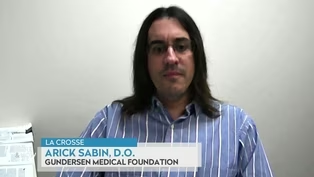
NewDr. Arick Sabin on Rising Lyme Disease Cases in Wisconsin
Video has Closed Captions
Clip: S2400 Ep2444 | 5m 44s | Dr. Arick Sabin on Lyme disease cases with warmer weather extending the deer tick season. (5m 44s)
 New
NewHere & Now opening for May 15, 2026
Video has Closed Captions
Clip: S2400 Ep2444 | 1m | The introduction to the May 15, 2026 episode of Here & Now. (1m)
 New
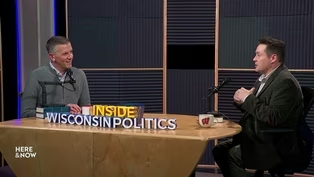
NewInside Wisconsin Politics: A Failed Bipartisan Spending Deal
Video has Closed Captions
Clip: S2400 Ep2444 | 5m 3s | Inside Wisconsin Politics on the Legislature voting down a state budget surplus plan. (5m 3s)
 New
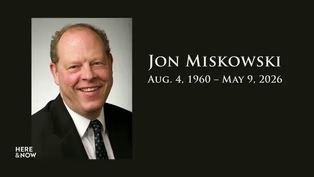
NewThe Legacy of PBS Wisconsin Emeritus Director Jon Miskowski
Video has Closed Captions
Clip: S2400 Ep2444 | 1m 23s | Jon Miskowski, emeritus director of television for PBS Wisconsin, has passed away at 65. (1m 23s)
 New
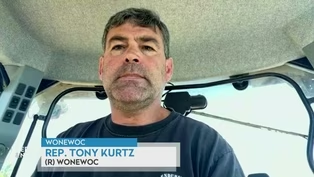
NewRep. Tony Kurtz on Backing Wisconsin's Budget Surplus Plan
Video has Closed Captions
Clip: S2400 Ep2444 | 13m 11s | Tony Kurtz on negotiations for a bipartisan state budget surplus deal that failed to pass. (13m 11s)
 New
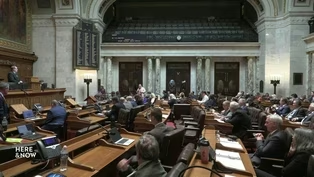
NewWisconsin's Bipartisan State Budget Surplus Deal Falls Apart
Video has Closed Captions
Clip: S2400 Ep2444 | 1m 52s | A bipartisan vote blocked a plan to boost school funds and send checks to taxpayers. (1m 52s)
Providing Support for PBS.org
Learn Moreabout PBS online sponsorship
- News and Public Affairs

Top journalists deliver compelling original analysis of the hour's headlines.

- News and Public Affairs

Today's top journalists discuss Washington's current political events and public affairs.












Support for PBS provided by:
Here and Now is a local public television program presented by PBS Wisconsin