
Ron Clark
Season 17 Episode 4 | 26m 46sVideo has Closed Captions
Educator Ron Clark talks about his passion for helping kids succeed with his grandma's rules!
Ron Clark is a New York Times-bestselling author, a school founder, and even an alum of the hit reality tv series Survivor. But before he was any of those things, Ron was a passionate educator from rural North Carolina. Alison finds out what connected him with Oprah, and sent him to the Whitehouse.
Problems playing video? | Closed Captioning Feedback
Problems playing video? | Closed Captioning Feedback
The A List With Alison Lebovitz is a local public television program presented by WTCI PBS
Ron Clark
Season 17 Episode 4 | 26m 46sVideo has Closed Captions
Ron Clark is a New York Times-bestselling author, a school founder, and even an alum of the hit reality tv series Survivor. But before he was any of those things, Ron was a passionate educator from rural North Carolina. Alison finds out what connected him with Oprah, and sent him to the Whitehouse.
Problems playing video? | Closed Captioning Feedback
Where to Watch The A List With Alison Lebovitz
The A List With Alison Lebovitz is available to stream on pbs.org and the PBS app.
Providing Support for PBS.org
Learn Moreabout PBS online sponsorshipThis week on the A-list, I find out how a small town school teachers, big ideas changed the game for students and educators around the world.
And so at the end of the year, I had the highest test scores in the school, and the principal said, ‘Oh my Gosh, how did you do this?
And I started to formulate, ‘Oh I know how I do this.
It's the way I structure my lesson.
It's my expectations.
It's the relationship building.
It's how I handle discipline.
It was all these different things I was doing.
And I said to myself, ‘I wish I could show everybody how to teach this way and how to motivate kids.
And that's when I had this idea, I said, ‘If I had a school where every teacher, the best teachers in America, were trying all these methods and people could come and sit and watch and learn and then take those ideas back to their schools.
We could make a revolution.
Join me as I talk with author and educator Ron Clark.
Coming up next on the A List.
Ron Clark is a New York Times bestselling author, a school founder, and even a former contestant of the hit reality TV show, “Survivor.” But before he was any of those things, Ron was a passionate educator in rural North Carolina.
His innovative teaching methods have taken him everywhere, from the white House to The Oprah Winfrey Show, and along the way, have made him an internationally recognized leader in the educational sphere.
In 2007, he co-founded Ron Clark Academy, a nonprofit middle school and educator professional development facility based right here in Atlanta.
And RCA is no typical middle school.
It is the physical embodiment of Ron's energy and passion, where innovation, wonder, and joy shape every student's journey.
I had the chance to get the full RCA experience by sitting in on a Ron Clark lesson and hearing how this one of a kind teacher brought his vision to life.
Well, Ron, welcome to the A List.
Thank you.
Glad to be joining you.
Thank you for welcoming us to, which I think is heaven on earth.
Oh, that's kind of you.
I was here a little over a year ago, seeing a friend of mine, Zyan Wynn, who teaches here and also is a graduate here.
And I want to tell you something: Just being in this building, this is not hyperbole, recalibrated the way that I face the world.
Because, Seriously?
It really did.
And I think my husband is so sick of me talking about it that I had to finally come back and tell you in person that the way that your team and your students greet every person who walks in here with such, authenticity and grace and respect.
I felt seen and heard and loved and these were kids who just met me.
And it happened again, walking into the building here.
I couldn't even get into the bathroom and out without them, you know, greeting me with just such kindness.
And it reminded me about this idea of being a thermostat everywhere we go and setting the climate.
And I talk about that a lot.
But coming to Ron Clark Academy reminded me how to do it.
So thank you.
Oh thank you.
I'm glad that you had that kind of experience here.
That's what we aim for.
We wanted to make a magical school that kids would love.
Our staff would love teaching here, and that people who visit it could feel the energy and the spirit of the building and the school.
So I'm glad it worked for you.
So let's go back now.
So before you were the, you know, namesake for this academy, you were Ron Clark from rural North Carolina.
Im from the country.
Yeah.
I grew up down dirt roads.
We, dug potatoes.
No one in my family had ever been to college.
I was the first one to go.
I was just working at the Dunkin Donut drive thru, and a local teacher passed away.
And my mom said, ‘Ron, you got to go teach.
They can't find teachers to go teach at the school.
And I didn't want to do it, but my mom twisted my arm.
So I went to the school and the principal said, oh, we need you.
This class has so many discipline problems.
You're just the man for the job.
And I said, no, I'm not.
And she said, what, you don't want the job.
I said, no, ma'am.
She said, then why are you here?
I said, my mama made me come.
I don't want the job.
But she said, can I at least introduce you to the students?
So she took me down the hallway and I looked in the class and they were throwing paper, and they're being loud.
And the substitute teacher was trying to teach her.
Her wig was off to one side.
She was floundering and I looked down and this kid goes, is you going to be our new teacher?
And I was like, I guess so.
And the principal said, really, you'll take the job?
I was like, I guess because I just had a feeling in my heart.
And the next day there I was, teaching in that class.
It was 1994, and I fell in love with it.
It was exciting and exhilarating and just trying to motivate the kids and get them excited and trying to bring it to life.
And when I saw kids who are like this, and then when I did things to make it exciting, they were like, oh, this is great.
I said, oh, what an amazing thing.
As a teacher, you have a chance to change the life of a kid.
This is something I think I want to do forever.
So that was the spark.
What led you from there to New York?
Sure.
So in North Carolina, I was doing lots of different stuff, I was rapping my lessons: ‘Now let's get down to some presidential learning.
We'll start with George Washington straight from Mount Vernon.
And I would do things like I would blow up balloons and the kids would work out math problems on balloons.
If they got it right, they could sit on it and pop it.
I had sunglasses we would wear when the problems got hard, we'd be detectives.
So I was doing all this stuff and I just thought it was silly and fun.
But then I had the highest test scores in the county, and the principal said, oh my God, we aint never had the highest test scores in the county.
And so she said, we should spread your methods around other classrooms.
So it started to spread and people suggested, I want to try that method, and I want to try that technique.
And eventually we were the highest scoring school in our county.
We got invited to the White House three different years.
And then I saw a TV show about schools in Harlem that have violence and overcrowded classrooms.
And I thought to myself, I know these methods work in the country.
Maybe they'll work in the city too.
And so during the summer, I packed up my car, drove to New York City to find one of those schools, and I found one.
You just went blind.
I aint got no sense.
And it's like, I think one of the greatest gifts humans can have is just being naive.
So your youth will lead you to some amazing places.
When we get older, we think about stuff too much.
But being naive, there's a lot to be said for that.
So I just did it.
Just drove up there looking around New York City.
So I found one of the schools, and I begged the principal and I got a job and it was challenging.
They made a movie about it.
You know, it's bad when they have to make a movie.
So I had 37 kids in my class and a lot of challenges and but I used the same methods in New York City that I had used in North Carolina.
I teach to the brightest kid in the class.
I try to get all the kids up to that level.
I work with the parents, I build relationships, I eat lunch with the students, just all those different things.
I don't waste time on my class.
We got a lot of learning to do.
We're not going to slow down.
It's gonna be high energy.
Let's go.
And so at the end of the year, I had the highest test scores in the school, and the principal said, oh my gosh, how did you do this?
And I started to formulate, ‘Oh, I know how I do this: It's the way I structure my lesson.
It's my expectations.
It's the relationship building.
It's how I handle discipline.
It was all these different things I was doing.
And I said to myself, I wish I could show everybody how to teach this way and how to motivate kids.
And that's when I had this idea, I said, ‘If I had a school where every teacher, the best teachers in America, were trying all these methods and people could come and sit and watch and learn and then take those ideas back to their schools.
We can make a revolution.
That's when I had the idea.
I was eventually named the American Teacher of the Year.
I got to be on The Oprah Winfrey Show, and Oprah told me to write a book.
So I wrote a book about how I teach.
And when Oprah says, write a book.
You write a book, you write the book because some of the audience may not understand.
But back in the day, if you were on The Oprah Winfrey Show, she had like 25, 26 million people a day watching that show.
That was a big deal.
It was the ‘Shark Tank effect now, right?
Like, if you were on that, that was it.
That's it.
And so for her to tell me to write a book on the show, I was like, well, I have to do it.
So my grandmamma raised me and she had 55 southern expectations.
When somebody drops something, you pick it up, I'd be at church, someone would drop something, and I knew I had to pick up whenever someone dropped something.
When I started teaching, I'd see somebody drop something.
And all the kids would stare at it and I'd be like, what are y'all doing?
They'll say, it's not mine.
I said, well, it doesn't matter.
But I didn't drop it.
I said, it doesn't matter.
You pick it up.
I said, no one has taught my grandmomma's rules to these kids.
Nobody's teaching good southern values of manners anymore.
So I said, I'm going to write down my grandmama's rules, and I'm going to teach them.
So I ended up with a list about 55.
And so I started teaching these rules to my students.
And once I did, they became nicer to each other and more respectful and polite.
And I was like, oh my goodness.
So sometimes you need to let kids know exactly what you expect.
So when Oprah told me to write the book, I wrote the book called The Essential 55, which is about my grandmama's rules.
And when the book came out, she made it one of her book picks.
I got to go back on the show.
She held the book up to the camera.
She said, America, I want you to go out right now and buy this book.
Then she held it close to her.
And when Oprah has some of top her bosoms, that's all it takes.
The book was number two in the nation, right behind one of them Harry Potter books.
And so the book made $840,000.
So I'm thinking, I'm rich.
I'm going gonna use this money.
Now I'm going to open a school.
I'm going to put it all in a foundation.
We're going up some school.
But in New York City, $840,000.
That's like a month's worth of payments for somewhere.
So at the time, Kim Bearden, who was the most decorated teacher in our country, lived in Atlanta.
I called her and said, Kim, I need you to move your family up to Harlem.
Come start a school with me.
I can't figure out how to do it.
She said, I'm not going to move my family to Harlem, but if you come to Atlanta, I'll consider it.
We came down here and we found this old factory in downtown Atlanta.
This was the second highest crime rate area of Atlanta.
There were drug houses on both sides and streetwalkers in front of this nasty old empty building.
And I said, this is it.
We're going to make this the school.
And I knew it was it because the building cost $840,000.
I said look at God, I said, we have exactly this much money.
The building cost this much.
It's meant to be.
And so we bought the factory.
But then we had 19 break ins.
As soon as you put copper piping in a building that's in a challenging area, people will want to get the copper piping and go recycle it.
So we had a lot of issues.
So I got a backpack.
I went all over the community.
I went to every house.
It took four months.
I went to the churches, the businesses, the homes, and Id say, ‘Hello.
My name is Ron Clark and I'm a schoolteacher.
I'm trying to start a school up the street, people keep breaking up into it.
Can I tell you about it?
And once we let the community know who we were, the break ins stopped.
And then finally, we got enough money to open the building.
And in our first year of operation, our eighth graders got a lot of money in scholarships.
Guess how much money they got in scholarships?
$840,000?
$840,000.
So at that moment, I knew.
Oh, we on to something here.
And this $840,000 - this is like God's way of saying this is where you supposed to be.
You doing the right stuff.
Now, last years, eighth graders here got $6 million in scholarships, so we've grown quite a bit.
But, I knew then we're in the right spot doing the right thing.
20 years later, it's clear that those early signs were pointing Ron in the right direction.
Watching the students at RCA today, there's no doubt that they are thriving in the supportive and dynamic learning environment that Ron and his team have created.
And it's no accident.
From teaching methodology to The Essential 55, each decision made in the school's creation was made with clear intention.
So how did you decide a middle school?
And then once you decided middle school, how did you decide which kids were going to be able to be in the first class and then successive classes?
Sure.
So in America, test scores for all kids on average increase until fifth grade.
For example, all Caucasian females, all African-American males, all Asian American females.
They all increase on average till fifth grade.
After fifth grade, every cohort group declines except for Caucasian females.
Y'all keep doing fine.
But the rest of us, we drop down.
So we wanted to build a middle school to show people how you can turn it in this direction, because there are a lot of ninth graders who want to drop out of school in America.
They don't want to drop out because what's going on in ninth grade, it's the deficiencies and what happened to them prior to that ninth grade year.
So we wanted to build a middle school to show that middle school could be a fun time, an exciting time, a time where test scores increase, kids love to come to school.
We went to all 50 states and we went to hundreds of high schools, middle schools, elementary schools.
Our team went everywhere, and there's some great high schools in America.
There's some high schools in America.
I was like, oh my God, that is so nice.
There's some great elementary schools.
We cried.
There's some beautiful elementary schools.
We did not find one middle school where when we walked out, we were like, well, that was lovely.
Every middle school was like, oh my God.
The teachers were frustrated, ‘These kids drive me crazy.
All the kids are like, ‘I hate school.
Middle school is just a hard time in the life of a kid.
So we wanted to show how you can make it a different experience for middle school kids.
Now you ask, why do we select the kids that we select?
Educators from all over the world visit here.
They come from China, Finland, Russia, India and all 50 states.
They come to our school to learn how to build a great school, and how to teach kids, and how to build a climate and culture.
So I needed to have some gifted kids in my classroom, because I need to show them how our methods affect gifted kids.
I need to have kids with learning disabilities.
I need to have a kid who has dyslexia.
I need to have a kid who's a discipline problem.
I need to have somebody who's well behaved.
I need to have...We wanted to make sure that we built a class of all different types of students, and we wanted our classes to have 30 kids in each.
So in our school, for every 30 kids, we've got all different types of kids.
in all different types of levels.
The one thing they have in common is that most students here, their families, pay $45 a month for them to attend our school.
We do have some middle income families and some high income families, but the majority of our kids, their families pay $45.
But we've had a 100% of our kids have graduated high school over the last 20 years, and we have 91% of our kids have graduated college, and they're at Harvard, Princeton, Yale, Morehouse, Spelman, Duke, Georgia Tech, University of Miami, UNC Chapel Hill.
They go to the best colleges, UGA, the best colleges in America, and they're the student government presidents.
And they're starting organizations and they're valedictorians.
So we feel like we have found the secret sauce here.
And what we do now is we share it with other schools so they can have a similar impact on their students as well.
So with success, we know comes sort of two lanes: The people who want to emulate you and celebrate you and the people who want to criticize you and say that can never work.
What kind of criticism have you gotten along the way?
And how have you sort of pushed back on the people who say, ‘Your, you know, ‘Essential 55 is too old fashioned or you're the level of enthusiasm and performative, you know, teaching in the class is not sustainable.
And that might work for Ron Clark, but that cant work at other schools.
How do you answer to the naysayers?
You know, it hasn't been so bad.
You know, I was just having a conversation with someone today that whenever you do anything, let's say at a school, you say, let's start a lacrosse program, and it's gonna take a lot of effort, but let's do it.
Once you've started at lacrosse program, someone's going to be upset because their kid didn't get the MVP trophy.
A parents upset because their kid doesnt play enough.
One kid's going to fall down, hurt his knee.
The mom is upset because of that.
There's a mom who does concessions, and she's upset because there's a father coming in trying to overtake her concession stand.
Whenever you do something in life, you have to understand there will be people that you will not make happy.
So going into RCA, I'm like, okay, do some big things here.
Its going to be a wild, big thing that we're trying.
I knew there would be some people that we wouldn't make happy in the grand scheme of things.
It hasn't been that bad.
The biggest critiques we have, it's someone who hasn't been here.
Because you'll see me on TikTok doing a dance, or I'm standing on a desk.
I may dance or rap once in a while.
Like in a day, maybe 10 seconds of my day I danced a little bit.
It doesn't happen here much, but if we put out ten academic videos on how great academic challenge and is and all of our, methods and techniques for academically challenging kids, no one watches those videos.
But if I do one, Take Me Thru There, Take Me Thru There video, it'll get 80 million views.
And so people assume, oh, RCA's the dancing school.
We're not a dancing school.
We move in class and we dance a little bit, so they'll think before they come here.
When an educator comes here and we have 160,000 or 170,000 who've been so far, and they've come to get training, they may see, oh, there might be some dancing or some shine, but that's only like 2% of what they're doing.
98% of what we do here.
It's how we question kids in classrooms, how we get kids to come to the board to do work, the rigor, the movement, the structure.
Just all of the great academics that we do in our classes.
That's the heart of RCA.
So educators may think before they come.
Oh, it's just singing and dancing.
Once theyre here they're like, oh, they're teaching me how to better instruct kids, how to engage them, how to challenge them, how to handle discipline problems, how to work better with parents.
So the only critiques we really have is people who they may have preconceptions before they get here.
Now, in terms of The Essentail 55 - you know, Katie Couric, I got to go on the Today Show and I'm thinking, oh my God, it's going to be so fun with Katie Couric.
And she sits down.
Her first question, she goes, ‘So, this Civil War mentality.
Are you afraid that you're bringing back because this, this pre-Civil War mentality of these manners and rules that you could create another civil war in America?
And I was like, What?” I was like, I was so taken by it.
I mean, the rules in the 55 rules, if someone drops something, pick it up.
If someone does, well, clap for them.
Hold the door for someone else.
Show courtesy when you clap.
When you wash your hands, do it appropriately.
What I'm doing, it's just good common sense.
Don't talk in a movie theater when other people are trying to focus on the movie.
So the 55 rules, they're not some archaic list of old fashioned rules.
They're good things of decency.
It's civility.
Yeah, it's the way to be a good friend and a good human and just to have kindness in the world.
So no, if anybody - and I rarely will hear that.
Katie Couric said it!
But I rarely hear anyone bring up something like that.
Once they've seen the rules, they're like, oh, this just common sense, good ways to teach our kids to be good humans.
The ethos behind Ron Clark Academy is one that clearly and intentionally encourages student growth in and outside the classroom.
And building blocks like the schools house system and The Essential 55 are foundational to achieving the RCA mission.
All right.
So civility, humanity, all of that: important.
Talk to me about rule 47.
I knew you were going to ask because people always do.
So rule 47 says there are no Doritos allowed in the building.
Yeah, that is triggering for me.
I have to say.
They stink so bad.
But honestly, when you've got 55 rules, you got to put some fun in there so that kids will not see it as 55 rules.
So I just made one that said, ‘no Doritos.
When I was a child, we would get one bag of Doritos every day for our snack.
My sister would take out the one Dorito, lick the cheese off, and put it back so I wouldn't have any of them because I'm, like, squeamish.
And so I never got a snack.
So it's just to this day, I told the kids I can't stand Doritos.
So it's just a rule and they know not to bring them.
Oh, that's the one rule that I knew about amongst all the others, because I'm a Dorito fan and I was told, don't even mention them in front of Mr.
Clark.
Well, nothing against Doritos.
They're a delicious snack, and the kids can have them all they want outside of RCA, just not in the building.
I want to talk about the wheel.
Sure!
And the houses.
I tell people it's sort of like a modern day Harry Potter and Hogwarts, but it really is.
You have these four houses that the kids are part of throughout their entire journey.
Yes, it's these are our families.
When the kids come on the first day of school, they spin the wheel.
They go up the stairs, they come shooting down the slide, and the wheel stops on one of the four houses.
And that is the house that you are in forever.
You could be in the green house of Isibindi, The House of Courage.
You can be in the house of Amistad, which means you're a good friend and you care for others.
You could be in Reveur.
[Howls] Were the wolves.
Which happens to be your house.
Its my house, we're dreamers.
Or Altruismo - I don't like them so much, thats our rival house.
They win everything.
Anyway, but Altruismo means ‘to give, use your talents to give.
But all of our students, our parents, our board members, our donors, our community members, everybody's in a house and we just use it to pull us all together.
Kids can earn points by being good academically or being kind or helpful.
So it's just a beautiful way to pull the whole school together.
So even though there's this inherent competition going on, I see in the classrooms, they do a lot of hand motions and that are all about support, inclusivity like encouragement.
So the the culture here might, you know, this is for fun and for bonding, but the culture is so encouraging and supportive.
What are all these the the [gestures] I was trying to understand it.
So I want the kids to not just sit there in class.
I want them to interact.
Even if you're not the one speaking.
I want you saying I agree with you, I disagree.
I want them cheering for each other.
And for example, if someone in Altruismo gets a question right - I was picking saying, oh gosh, they win everything - but if they get something right we all cheer for them.
Were all going to cheer for them - ‘Is she on?
Wipe her down, - we're all going to celebrate each other.
We have a house system not to tear us apart, but to pull us together.
So no matter who wins, we all cheer for them.
We would like to win as well, but when you win, we're happy for you too.
How do you think that translates once they leave the school?
It's ingrained because they're here for five years when they leave.
We've taught them to cheer for others, to be a good friend, to uplift other people, and to realize, not everything's for you.
You didn't win homecoming queen.
That wasn't for you.
That was for someone else.
And in life, sometimes things won't be for you.
But when something's not for you, go out there and find what is for you.
And so it's a concept that we try to build them, to help them throughout life.
So we're on the stairwell, but I can't help notice the two giant spiral slides.
What is going on with those?
We wanted symbols in our building to symbolize that a lot of people in life take stairs.
Businesses and people do the same things that everyone else has always done, the same way you've always done it.
We say in life you have to be willing to take a different path, try things no one else has ever tried before.
And that's what we do as a school.
We show other schools: ‘You don't have to do things the way you've always done it.
We can be better and different and innovative.
We can take a different path.
That's what the slides symbolize.
But it's not only for schools is for our kids too.
Hope in life that every kid will say, I don't have to do what everyone's always done.
I can start my own path.
I can be different.
I can be bold.
I can slide.
From his early days in rural North Carolina to the realization of his dream of sharing his innovative methods with educators around the world.
Ron has embodied the notion of creating your own path.
So I couldn't leave Ron Clark Academy without following his example.
All right, so before I leave, I got to ask, do you think I can get slide certified?
It's a tradition.
You have to.
All right, any pointers?
You want to cross your arms like this, close your eyes and think: ‘Revolution.
Then go on down and drop.
We knew you were coming so we waxed them suckers.
They'll be good and fast.
All right.
I think I might have some people waiting for me at the end.
Let's do it.
So you can take Big Blue or The Monster has a kick to it.
Oh, I'm going to do The Monster.
Let's do The Monster.
You would do The Monster, right?
Of course.
If you're going to be here, be here.
All right, I don't know.
I forgot the whole little jig, but.
Put your both hands there.
Put both feet there.
Oh, gosh.
Okay.
And then cross your arms.
Hit it everyone!
1-2-3.
Youve been slide certified!
Thank you, thank you.
Yall are awesome!
Watch even more of the shows you love any time with WTCI Passport, an exclusive benefit for members of WTCI PBS.
Watch your favorite shows in Passport on the free PBS app.
Download it today.
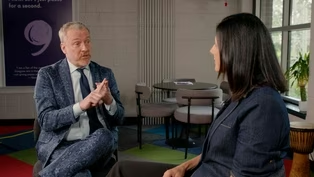
How Ron Clark fell in love with teaching
Clip: S17 Ep4 | 1m 33s | Ron Clark didn't know where his teaching journey would take him when he showed up for the job. (1m 33s)
Providing Support for PBS.org
Learn Moreabout PBS online sponsorship New Season
- Drama

Hugh Bonneville stars in a crime drama inspired by one of the largest robberies in British history.
 New Episode
- News and Public Affairs

Top journalists deliver compelling original analysis of the hour's headlines.
 New Season
 New Episode
 New Episode

 New Episode


Support for PBS provided by:
The A List With Alison Lebovitz is a local public television program presented by WTCI PBS